The Weekly Power Hour: A Simple Planning Ritual That Actually Works

Why do some weeks feel like you’re steering and others feel like you’re just getting dragged along?

Same job. Same responsibilities. Same 168 hours. But some weeks you end up in control, ticking off the stuff that matters, feeling like a functioning human. Other weeks you spend the whole time putting out fires, reacting to whatever’s loudest, and arriving at Friday wondering what even happened.

The difference usually isn’t what happens during the week. It’s what happens before it starts.

One hour of intentional planning changes everything. Not a casual glance at your calendar. Not a mental run-through while you’re doing something else. An actual dedicated hour where you step back, look at what’s coming, and decide in advance how you’re going to handle it.

People who do this consistently don’t have fewer problems or more hours. They just stop being surprised by their own lives.

What Actually Happens in a Power Hour

The name sounds intense but the process is pretty simple. You’re doing three things: clearing the mental clutter from last week, mapping out what’s actually on your plate this week, and making real decisions about what gets your time and attention.

Start with a brain dump. Everything that’s floating around in your head goes onto paper. Tasks you didn’t finish. Things you’ve been meaning to do. Appointments you need to schedule. People you need to follow up with. Worries. Ideas. Random stuff you keep remembering at 2 AM. Get it all out.

This part alone is worth the hour. Research from the American Psychological Association shows that externalizing your mental load reduces stress and improves focus. Your brain isn’t designed to hold open loops. When you dump everything onto paper, you’re giving your mind permission to stop trying to remember it all.

Next, look at your actual calendar. What’s already scheduled? What deadlines are coming? What commitments did past-you make that present-you now has to honor? Get clear on the fixed points of your week before you try to add anything else.

Then comes the important part: deciding what actually matters. Out of everything on your brain dump and calendar, what are the three to five things that would make this week feel successful? Not everything you could do. Not everything you should do. The stuff that genuinely moves the needle.

Those priorities get scheduled first. Real time blocks, not just a hopeful to-do list. If it’s not on the calendar, it’s not going to happen.

Finally, look at what’s left. Some of it can wait until next week. Some of it can be delegated. Some of it, honestly, can just be deleted because it doesn’t actually matter and you’ve been carrying it around out of guilt.

A weekly planner that shows your whole week at a glance makes this process way easier. Seeing everything laid out in one view helps you spot conflicts, find open space, and make realistic decisions about what can actually fit.

When to Do It

Most people do their power hour on Sunday. Late afternoon or evening works well because the weekend is winding down and Monday is close enough to feel real. You can look at the week ahead with fresh eyes before you’re already in the middle of it.

Some people prefer Friday afternoon. The advantage there is that you close out the work week with clarity about what’s next, so you can actually relax over the weekend instead of carrying vague anxiety about Monday. You also have fresher memory of what happened during the week you just finished.

Either works. The timing matters less than the consistency. Pick a slot and protect it like an important meeting, because it is one. A meeting with yourself about how you’re going to spend your limited time and energy.

If an hour sounds like a lot, know that it gets faster with practice. The first few times might take longer as you figure out your process. Once it’s a habit, some weeks you’ll be done in 30 or 40 minutes. Other weeks, when life is complicated, the full hour is necessary. Build in the time and use what you need.

What to Actually Cover

Here’s a simple structure that covers the essentials without overcomplicating things:

  • Review last week. What got done? What didn’t? What do you need to carry forward?
  • Check your calendar. What’s already committed? Any conflicts or problems to solve?
  • Brain dump. Clear everything out of your head onto paper.
  • Identify priorities. What 3-5 things actually matter this week?
  • Schedule the priorities. Block real time for the important stuff.
  • Plan meals and logistics. What does the week look like practically?
  • Note one personal thing. Something just for you that isn’t work or obligation.

The personal thing matters more than it sounds. When your week is all tasks and responsibilities, burnout creeps in fast. Scheduling something you actually want to do, even if it’s small, keeps you from turning into a productivity robot who forgot how to enjoy anything.

If you’re struggling with daily structure in general, figuring out how to build a daily routine that actually works can make your weekly planning sessions way more effective because you have a stable foundation to build on.

Why This Works When Other Planning Doesn’t

You’ve probably tried planning before. To-do lists that grow endlessly. Apps that you used for two weeks and then abandoned. Planners that sit mostly empty because you never actually sit down to fill them out.

The power hour works differently because it’s not just making a list. It’s making decisions.

A to-do list collects everything. A power hour forces you to prioritize. You can’t just add things indefinitely because you’re looking at a finite week with finite hours. When you see that you have 12 hours of real work time available and 30 hours worth of tasks, you have to choose. That choosing is where the magic happens.

The other difference is the dedicated time. Most planning happens in scraps. A few minutes here, a quick look there, mental planning while you’re doing something else. That scattered approach means you never get the full picture. You’re always working with incomplete information.

The power hour gives you altitude. For one hour, you’re not in the weeds of execution. You’re above the week, looking down at it, seeing how the pieces fit together. That perspective changes everything.

People who plan their year intentionally, like what’s covered in how to plan the new year without giving up by February, use the same principle at a bigger scale. The weekly version just makes it sustainable and actionable.

The Compound Effect Over Time

One power hour doesn’t transform your life. But 52 of them, stacked over a year? That’s a different story.

Each week you get slightly better at estimating how long things take. You learn what your actual capacity is versus your optimistic fantasy capacity. You notice patterns in what keeps not getting done and can finally address why. You build evidence of your own follow-through, which builds confidence for bigger commitments.

Research from Dominican University found that people who write down their goals and create action plans are significantly more likely to achieve them. The power hour is essentially a weekly goal-setting and action-planning session. Do it consistently and you’re stacking the odds in your favor week after week.

You also start seeing your life at a different level. Instead of just surviving each day, you’re intentionally shaping your weeks. Instead of hoping things work out, you’re designing how they’ll go. That shift from reactive to proactive changes everything about how capable you feel.

The practices that make habits stick, like the ones in 10 atomic habits hacks that actually work, apply here too. Attach your power hour to a consistent trigger. Do it in the same place each time. Reward yourself after with something you enjoy. Make it easy to start.

What Changes When You Actually Do This

Monday stops being chaotic. You already know what you’re focusing on. You’ve already looked at your calendar. You’ve already made the hard decisions about what matters and what can wait. Monday becomes execution, not scrambling.

Overwhelm decreases. Not because you have less to do, but because you can see it all clearly. Overwhelm often comes from the invisible pile of stuff you know you’re forgetting. When everything is captured and organized, the pile becomes manageable.

You stop dropping balls. The follow-up you keep forgetting. The birthday card you mean to send. The appointment you need to schedule. These things get caught in the weekly review instead of slipping through the cracks repeatedly.

You make progress on things that matter. The important-but-not-urgent stuff that always gets pushed aside finally gets time blocked and actually done. The book you want to write. The project you keep meaning to start. The relationship you’ve been neglecting. They get scheduled so they stop being someday and start being Tuesday at 2 PM.

And here’s the unexpected part: you feel more relaxed, not less. Planning sounds like more work, but good planning reduces the mental load you’re carrying constantly. You can be fully present on Saturday because you’re not trying to remember everything you need to do Monday. It’s all written down. The system is holding it.

If you’re looking to reset things more broadly, combining a weekly power hour with the strategies in how to reset your life can create serious momentum.

Starting This Week

Back to the question from the beginning: why do some weeks feel like steering and others feel like getting dragged?

The answer is usually about one hour that either happened or didn’t.

Pick your time. Sunday evening. Friday afternoon. Whatever works for your life. Block it on your calendar right now before something else fills that space.

Grab your planner or a notebook. Sit down when the time comes. Dump everything out. Look at your week. Make real decisions about what matters. Schedule the priorities.

Do it once and it’ll feel useful. Do it every week for a month and you won’t recognize how different things feel. Do it for a year and you’ll wonder how you ever functioned without it.

One hour. Every week. That’s the whole ritual. Simple enough that there’s no excuse not to try it.

The Complete Semaglutide Food Guide: What to Eat and What to Skip

There is no Ozempic diet.

No special meal plan. No proprietary food list that came with your prescription. No secret combination of ingredients that unlocks the full potential of semaglutide or tirzepatide.

That’s actually good news. It means you don’t need to overhaul your kitchen or follow some rigid protocol that falls apart the first time you eat at a restaurant. But it also means the responsibility falls on you to figure out which foods help your medication work better, which ones make the side effects worse, and which ones quietly undermine your results without you realizing it.

Four major medical organizations published a joint advisory in 2025 that said it plainly: GLP-1 medications are most effective when paired with intentional, nutrient-dense eating patterns. The drugs handle appetite. Your food choices handle everything else.

This guide breaks down exactly what that looks like in practice. What to eat, what to skip, how to time your meals, how to deal with nausea days, and how to build a plate that supports your results without requiring a nutrition degree.

How Your Medication Changes the Way You Eat

Before getting into specific foods, it helps to understand what’s happening in your body. Semaglutide and tirzepatide both slow gastric emptying, which is a clinical way of saying food stays in your stomach longer. That’s why you feel full faster and stay full longer.

This changes the game in two ways.

First, you’re eating less overall. Most people on GLP-1 medications naturally reduce their calorie intake by 20 to 40%. That sounds great until you realize it means you’re also getting 20 to 40% fewer vitamins, minerals, and protein than before. Every bite carries more weight now.

Second, certain foods that never bothered you before might suddenly make you miserable. High-fat meals, large portions, greasy takeout, sugary drinks. Your stomach is processing everything more slowly, and foods that are hard to digest can sit there for hours, causing nausea, bloating, and that heavy “why did I eat that” feeling.

The goal of a good GLP-1 eating strategy isn’t restriction. It’s efficiency. You’re working with a smaller window of food intake, so you need to make those calories count.

The Foods That Work With Your Medication

These are the categories that should make up the majority of what you eat. Not because someone told you to, but because they deliver the most nutrition per bite while keeping side effects low.

Lean Protein

Protein is the foundation of everything on a GLP-1 medication. It preserves muscle during weight loss, keeps you full between meals, and has a higher thermic effect than carbs or fat, meaning your body burns more energy just digesting it.

Best sources:

  • Chicken breast and turkey
  • White fish like cod, tilapia, and sole
  • Shrimp and other shellfish
  • Eggs and egg whites
  • Greek yogurt and cottage cheese
  • Tofu, tempeh, and edamame
  • Lentils, black beans, and chickpeas

A few things to know. Red meat sits in your stomach longer than poultry or fish, and since semaglutide already slows gastric emptying, that combination can cause real discomfort. If you eat beef, go lean and keep portions small. Fattier cuts like ribeye or ground beef over 85% lean tend to be the worst offenders for nausea.

Aim to eat protein first at every meal. When your appetite is reduced, you fill up faster, and you want the protein in before you run out of room. This alone can make a noticeable difference in how you feel and how much muscle you hold onto.

How much protein? Most research suggests 1.2 to 1.5 grams per kilogram of body weight daily for GLP-1 patients. For someone who weighs 170 pounds, that’s roughly 90 to 115 grams per day. If you’re also strength training (and you should be), push that closer to 1.6 to 2.0 grams per kilogram.

For the days when solid protein feels impossible, a shake can bridge the gap. Orgain Organic Protein is what I keep coming back to for GLP-1 users specifically. Twenty-one grams of plant-based protein per scoop, smooth texture that doesn’t trigger nausea, and it goes into smoothies, overnight oats, or just water when you need something quick.

It’s not a replacement for real food, but on the days when real food isn’t cooperating, it keeps you from falling behind.

Non-Starchy Vegetables

These are your volume foods. Low in calories, high in fiber, and packed with the micronutrients your body needs more than ever now that you’re eating less overall.

Best picks:

  • Broccoli, cauliflower, and Brussels sprouts
  • Spinach, kale, and mixed greens
  • Zucchini and yellow squash
  • Bell peppers (any color)
  • Green beans and asparagus
  • Cucumbers and tomatoes
  • Mushrooms

One thing to watch: raw vegetables can sometimes cause bloating on GLP-1 medications because of the slower digestion. If that’s happening to you, try roasting, steaming, or sauteing them instead. Cooked vegetables are easier on a sensitive stomach and still deliver the same nutrients. Roasting with a light drizzle of olive oil actually makes some nutrients more bioavailable.

See also: The GLP-1 Grocery List: Everything You Need in One Trip

Fiber-Rich Complex Carbs

You don’t need to cut carbs. You need to pick the right ones. Complex carbohydrates with fiber help stabilize blood sugar, support digestion, and feed the gut bacteria that actually produce natural GLP-1 in your intestines.

Good choices:

  • Oats (rolled or steel-cut, not instant flavored packets)
  • Quinoa
  • Sweet potatoes
  • Brown rice
  • Whole grain bread (check for at least 3g fiber per slice)
  • Barley
  • Legumes: black beans, chickpeas, lentils

A 2025 narrative review published in Nutrients found that prebiotics and fiber-rich foods may actually support GLP-1 therapy by feeding the gut microbiome. Short-chain fatty acids produced by fermenting fiber in the gut trigger additional GLP-1 release from intestinal cells. In plain terms: eating fiber helps your body produce more of the same hormone your medication is mimicking.

That’s worth repeating. The right carbs don’t just provide energy. They amplify what your medication is already doing.

Healthy Fats (in Small Amounts)

Fat isn’t the enemy, but it is the nutrient most likely to make you nauseous on a GLP-1 medication. The key is choosing the right sources and keeping portions modest.

Best options:

  • Avocado (start with a quarter, not half)
  • Extra virgin olive oil
  • Nuts: almonds, walnuts, pistachios
  • Seeds: chia, flax, pumpkin
  • Fatty fish: salmon, sardines, mackerel

A quarter of an avocado is different from half an avocado when your stomach is processing food at half its normal speed. Start small and see how you feel. You can always add more later.

Omega-3 fatty acids from fish and flaxseed deserve a special mention. Research suggests they may reduce inflammation and help preserve lean mass during weight loss, both of which matter when you’re on these medications.

Hydrating Foods

Dehydration is one of the sneakiest problems on GLP-1 medications. You’re eating less food, which means less water from food. Some of these foods pull double duty by keeping you hydrated while providing nutrients.

  • Watermelon and cantaloupe
  • Cucumbers
  • Strawberries and blueberries
  • Broth-based soups
  • Zucchini
  • Lettuce and celery

On days when drinking water feels like a chore, eating it is a decent workaround.

For Research Purposes Only

Mile High Compounds | The Gold Standard in Peptide Testing

If you’re exploring research peptides alongside your health optimization, Mile High Compounds is where I’d start. They’re a Colorado-based supplier that runs 7x testing on every single batch: purity, sterility, endotoxins, heavy metals, identity, net content, and conformity. All compounds are sourced from cGMP-certified, FDA-audited facilities, and every order ships with a full Certificate of Analysis.

Their catalog covers BPC-157, GHK-Cu, Thymosin Beta 4, GLP-1 research compounds, peptide blends, bioregulators, and more. Same-day shipping on orders placed before 3PM PST.

🧬 7x Tested   |   cGMP Certified   |   COAs on Every Batch   |   Same-Day Shipping

Use code BRAINFLOW for 10% off your order

Foods to Limit or Avoid

None of these foods are permanently off limits. But while you’re on a GLP-1 medication, they’re more likely to cause problems than they’re worth.

Fried and Greasy Foods

This is the number one trigger for nausea and vomiting on semaglutide and tirzepatide. French fries, fried chicken, onion rings, doughnuts, anything cooked in a deep fryer or swimming in oil.

The problem is mechanical. Your medication already slows down how fast food leaves your stomach. High-fat, greasy food slows it down even further. The result is food sitting in your stomach for hours, causing that heavy, nauseous, “I made a terrible mistake” feeling that many GLP-1 users know too well.

If you’re craving something crispy, try air frying instead. It gets you close to the texture without the grease load. Air-fried chicken tenders with a light breading are a completely different experience than deep-fried ones when your stomach is this sensitive.

Sugary Foods and Drinks

Candy, pastries, soda, sweet tea, fruit juice, flavored coffee drinks with pumps of syrup. These spike your blood sugar fast and crash it just as fast, which can trigger nausea and energy crashes on top of whatever your medication is already doing.

Semaglutide works partly by improving blood sugar regulation. Dumping a bunch of refined sugar into that system is like slamming the brakes and the gas at the same time.

The occasional treat won’t derail your progress. But if sugary drinks are a daily habit, switching to water, unsweetened tea, or sparkling water makes a noticeable difference in how you feel on the medication. Most people are surprised by how much better their energy stays when they cut the liquid sugar.

Ultra-Processed Snacks

Chips, packaged cookies, frozen meals with ingredient lists longer than this paragraph, protein bars that are basically candy bars with a marketing budget. These foods are engineered to make you eat more, which directly fights the appetite reduction your medication provides.

They’re also calorie-dense and nutrient-poor. When you’re eating fewer total calories, you can’t afford to waste them on food that gives your body nothing useful in return. A 300-calorie bag of chips gives you sodium and fat. A 300-calorie meal of chicken, rice, and vegetables gives you protein, fiber, vitamins, and sustained energy. Same calories. Wildly different outcomes.

Alcohol

Alcohol and GLP-1 medications are not a great combination. Both slow gastric emptying. Both can cause nausea. Both affect blood sugar. Put them together and the effects compound.

Many people on semaglutide report feeling alcohol’s effects faster and stronger, even at amounts that never bothered them before. That’s partly because you weigh less and partly because the medication changes how your body processes alcohol.

If you drink, go slowly. Eat before drinking. Stick to lower-sugar options like dry wine or clear spirits with soda water. And pay attention to how your body responds, because it will likely be different than it was before you started the medication.

Spicy Foods (For Some People)

This one is individual. Some people tolerate spicy food fine on GLP-1 medications. Others find that anything with heat triggers acid reflux, heartburn, or intensified nausea.

If spicy food was never a problem for you before, try it cautiously and see what happens. If it was already borderline, your medication may push it over the edge. The slowed gastric emptying means spicy food sits longer, and the capsaicin has more time to irritate your stomach lining.

Carbonated Drinks

Soda, sparkling water, and seltzer can cause bloating and gas that’s amplified by your medication. When your stomach empties slowly, carbonation has nowhere to go. It just builds pressure.

Some people tolerate sparkling water fine. Others feel like a balloon after two sips. If you’re not sure, test it with a small amount and see how your body reacts before committing to a full can.

You might also like: The GLP-1 Restaurant Guide: How to Eat Out Without the Side Effects

Meal Timing and Portion Strategy

How you eat matters almost as much as what you eat when you’re on these medications.

Smaller Meals, More Often

Three moderate meals and one or two small snacks tends to work better than two large meals or skipping meals entirely. Your stomach is processing food more slowly now. Smaller inputs mean less backup, less nausea, and more consistent energy throughout the day.

A practical breakdown might look like this:

  • Breakfast: protein-focused, 300-400 calories
  • Mid-morning snack: small, 100-150 calories (Greek yogurt, handful of nuts)
  • Lunch: balanced plate, 400-500 calories
  • Afternoon snack if needed: 100-150 calories
  • Dinner: balanced plate, 400-500 calories

Those ranges are loose on purpose. Your appetite will vary day to day, and some days you’ll eat less than others. The point isn’t to hit exact numbers. It’s to spread your intake out instead of cramming everything into one or two sittings.

Eat Slowly. Seriously.

This sounds obvious, but most people underestimate how fast they eat until they start paying attention. On a GLP-1, your fullness signals arrive sooner than they used to. If you’re eating fast, you’ll overshoot your satiety point and feel miserable 20 minutes later.

Put your fork down between bites. Actually chew your food. Have a conversation during dinner instead of scrolling your phone. These small changes give your brain time to register what your stomach already knows.

Don’t Skip Meals

Even when you’re not hungry. Especially when you’re not hungry. Your body still needs nutrients. Skipping meals leads to undereating protein, missing micronutrients, and eventually compensatory overeating when your hunger catches up with you at 9 PM.

If a full meal feels like too much, eat half of one. Something is always better than nothing on these medications.

The Nausea Toolkit: What to Eat on Bad Days

Some days, especially in the first few weeks or after a dose increase, nothing sounds good. Everything feels like it would make you sick. You still need to eat something.

Here’s what tends to work when your stomach is protesting.

Bland and Easy to Digest

  • Plain crackers or toast
  • White rice
  • Bananas
  • Applesauce
  • Plain baked potatoes
  • Plain oatmeal

Nothing spicy, nothing greasy, nothing with strong flavors. Think of it as the adult version of what your mom fed you when you had a stomach bug. Boring is the goal on these days.

Broth-Based Soups

Underrated and underused. Broth-based soups provide hydration, some sodium, and a small amount of nutrition without making your stomach work hard. Chicken broth with a few noodles, miso soup, or a simple vegetable soup can be enough to get you through a rough afternoon.

Keep a few cans or cartons of low-sodium chicken broth in your pantry. On bad nausea days, warming up a mug of broth is sometimes all you can manage, and that’s fine.

Cold Foods

Cold foods sometimes go down easier than hot foods. Greek yogurt, cottage cheese, smoothies, cold fruit, popsicles made from real fruit. The temperature seems to help with nausea for a lot of people, though nobody has a great explanation for why.

If even cold solid food is too much, a protein shake on ice is your fallback. A Magic Bullet blender makes this a 30-second operation. Scoop of protein powder, ice, water or almond milk, blend, done. On the worst days, this might be your only “meal” for a few hours, and that’s okay. It still delivers 20+ grams of protein, which is 20 more grams than skipping it entirely.

Ginger for Nausea Relief

Ginger has been studied for nausea relief across multiple conditions, and many GLP-1 users swear by it. Options include:

  • Ginger tea (steep fresh ginger slices in hot water)
  • Ginger chews or candies
  • Flat ginger ale (let it go flat first so the carbonation doesn’t add to the bloating)
  • Fresh ginger added to smoothies

Peppermint tea is another option that some people find helpful for settling their stomach, especially after meals.

Related Reading: The GLP-1 Hydration Guide: Why Water Matters More Than You Think

What to Drink (and What to Skip)

Hydration gets its own section because dehydration is one of the most common and most underdiagnosed problems on GLP-1 medications. When you eat less food, you also get less water from food. Add nausea or vomiting into the mix and you can dehydrate fast.

Drink More Of

  • Water (8-12 cups daily, sipped throughout the day)
  • Herbal tea: peppermint for nausea, ginger for stomach settling, chamomile for evenings
  • Water infused with fruit or cucumber for flavor
  • Bone broth (counts toward hydration and adds protein)

Drink Less Of or Skip

  • Soda (sugar and carbonation, double problem)
  • Fruit juice (liquid sugar with no fiber)
  • Sweetened coffee drinks (a grande mocha can have 40+ grams of sugar)
  • Energy drinks
  • Alcohol (see above)

Sip throughout the day rather than chugging large amounts at once. Large volumes of liquid can trigger nausea on these medications, especially right before or after a meal. Try to separate drinking and eating by about 30 minutes when possible.

Electrolytes matter more than most people realize. When you’re eating less and potentially losing water through GI side effects, your sodium, potassium, and magnesium levels can drop. LMNT is my go-to electrolyte mix because it has actual functional doses of sodium and potassium with no sugar.

One packet in your morning water, one in the afternoon if you need it. It pairs with your meals rather than replacing them, and it doesn’t have the artificial sweetener taste that most electrolyte products do.

Building Your Plate: The Simple Formula

If you want one visual to guide every meal, here it is.

  • Half your plate: non-starchy vegetables
  • One quarter: lean protein
  • One quarter: complex carbs or healthy fats

That’s it. No calorie counting required for most people, especially in the early months when appetite is naturally suppressed.

What This Looks Like in Real Life

For breakfast, two scrambled eggs with spinach and a slice of whole grain toast takes five minutes and puts protein front and center. If cooking feels like too much, Greek yogurt with berries and a tablespoon of chia seeds works just as well with zero effort.

Lunch could be grilled chicken over mixed greens with cucumbers, tomatoes, quinoa, and a drizzle of olive oil. The protein is the star. The vegetables fill the plate. The quinoa adds fiber and sustained energy. Or go portable with a turkey and avocado wrap in a whole wheat tortilla with lettuce and a side of baby carrots.

At dinner, try baked salmon, roasted broccoli and bell peppers, and half a sweet potato. Same plate formula, different ingredients. A stir-fry works too: shrimp with zucchini, snap peas, and mushrooms over brown rice, light on the oil, heavy on the vegetables.

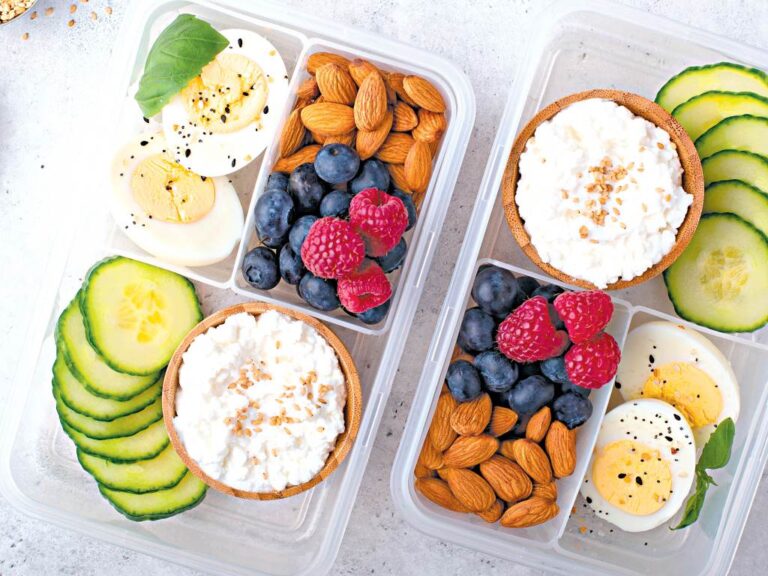
For snacks, keep it simple. Hard-boiled eggs, string cheese, a small handful of almonds, apple slices with a tablespoon of peanut butter, cottage cheese with cucumber slices, or a protein shake when you need something fast.

Repeat this pattern with enough variety to keep things interesting and you’ll cover your nutritional bases without overthinking it.

Foods That Naturally Boost GLP-1

This is a piece most food guides leave out. Certain foods stimulate your body’s own GLP-1 production, which can work alongside your medication to keep appetite and blood sugar in check.

According to a 2025 joint advisory from four major medical organizations, dietary modulation of endogenous GLP-1 is an emerging area of interest. Foods that trigger natural GLP-1 release include:

  • Prebiotic fibers: garlic, onions, leeks, asparagus, bananas
  • Fermented foods: yogurt, kefir, sauerkraut, kimchi
  • Resistant starches: cooled potatoes, cooled rice, green bananas, oats
  • Omega-3 rich foods: fatty fish, walnuts, flaxseed

You’re feeding the bacteria in your gut that produce additional GLP-1. It’s not going to replace your medication, but it can support the effect, especially as you eventually taper down or come off the drug.

Supplements Worth Considering

When you’re eating 30 to 40% fewer calories, certain nutrients become harder to get from food alone. A 2025 expert consensus published in Obesity Pillars specifically recommended monitoring GLP-1 patients for nutritional insufficiencies and considering supplementation where gaps exist.

The most commonly flagged deficiencies in GLP-1 patients:

  • Vitamin D
  • Calcium
  • Iron
  • Vitamin B12
  • Zinc
  • Magnesium

All of these can cause symptoms that mimic or worsen the side effects of the medication itself. Fatigue, brain fog, muscle weakness, hair thinning. Sometimes what feels like a medication problem is actually a nutrition problem hiding underneath it.

An Amazon Basics daily multivitamin won’t fix a serious deficiency, but it covers the basics while you figure out your new eating patterns. Think of it as the floor, not the ceiling. If you’re losing hair, exhausted all the time, or noticing new symptoms three or more months in, ask your doctor to run bloodwork and check specific levels.

Fiber supplements can also help if you’re struggling with constipation, which is one of the more persistent GLP-1 side effects. Psyllium husk mixed into water or a smoothie adds bulk without adding many calories.

Common Mistakes to Avoid

After reading hundreds of GLP-1 food discussions, the same mistakes come up over and over. Here are the ones that trip people up the most.

Eating too little. The medication suppresses your appetite, and some people take that as permission to barely eat at all. Undereating leads to muscle loss, nutrient deficiencies, fatigue, hair loss, and eventually a metabolic slowdown that makes maintaining your weight harder later. You still need to eat. Just eat smarter.

Not drinking enough water is another one that catches people off guard. Dehydration sneaks up on you when you’re eating less food. Headaches, constipation, dizziness, and brain fog that people blame on the medication are often just dehydration in disguise.

Skipping protein. When everything sounds unappealing, people reach for crackers and bread because they’re easy. But if most of your reduced calories come from carbs, you’re losing muscle at an accelerated rate. Protein first. Always.

Relying on willpower instead of systems trips up a lot of people too. The ones who eat well on GLP-1 medications are not the ones with the most discipline. They’re the ones who meal prep on Sunday, keep their fridge stocked with easy proteins, and have a blender on the counter for the days when cooking feels like too much.

And finally, not adjusting as you go. What works in month one might not work in month four. Your tolerance changes, your appetite shifts, your weight changes. Check in with how you’re eating every few weeks and make adjustments instead of running on autopilot.

More on this: Thinking About Stopping GLP-1? How to Transition Without Regaining

Quick Reference: Your GLP-1 Food Cheat Sheet

Eat more of: lean protein (chicken, fish, eggs, Greek yogurt), non-starchy vegetables, legumes, whole grains, water-rich fruits like berries and melon, ginger tea, broth-based soups, prebiotic-rich foods

For the middle ground, red meat in lean cuts, starchy vegetables like potatoes and corn, whole grain pasta, nuts and nut butters, cheese, and avocado are all fine in moderation. Watch portions since these are calorie-dense.

Skip or limit: fried foods, greasy fast food, sugary drinks, candy and pastries, alcohol, ultra-processed snacks, carbonated beverages (if they cause bloating), spicy food (if it triggers reflux)

Print this out, stick it on your fridge, and don’t overthink it.

Your Diet Is the Variable You Control

The medication handles your appetite. Your doctor handles the dose. Insurance handles the cost (or doesn’t, depending on your luck). But the food you put in your body every day? That’s yours.

And honestly, that’s the part that determines whether this medication becomes a turning point or a temporary experiment. The people who get lasting results on GLP-1 medications aren’t the ones who follow some perfect diet. They’re the ones who figured out a handful of meals that work for them, built those meals into a repeatable routine, and stopped treating food like something to be afraid of.

You don’t need to eat perfectly. You just need to eat intentionally. The medication bought you time and space to build better habits. Use it.


How to Stop Ozempic or Mounjaro Without Gaining the Weight Back

You’ve been thinking about it for a while now.

Maybe it’s the cost. Maybe your insurance stopped covering it. Maybe the side effects have worn you down, or you’ve hit your goal weight and you’re wondering if it’s time to try life without the injection.

Whatever the reason, the idea of stopping your GLP-1 medication has been sitting in the back of your mind. And right behind it is the fear that everything you’ve worked for will unravel the second you stop.

That fear isn’t irrational. A 2026 meta-analysis published in the BMJ found that people who stopped semaglutide or tirzepatide regained an average of 22 pounds within the first year. At that rate, most people returned to their starting weight within 18 months.

That’s the headline number. But headlines don’t tell the whole story.

A separate study from Cleveland Clinic, published in 2025, found something different in real-world patients. Many people who stopped semaglutide or tirzepatide in everyday clinical settings did not experience the rapid weight regain that clinical trials predicted. The trajectories were more stable, the regain was slower, and some people maintained a significant portion of their losses.

The difference between the trial patients and the real-world patients? Mostly preparation. The trial patients stopped cold. The real-world patients had often built habits, tapered down, and worked with their doctors on an exit plan.

That’s what this article is about. Not scaring you into staying on your medication forever. Not pretending the risk doesn’t exist. Just giving you an honest look at what happens when you stop, and what you can do to keep the weight off if you decide it’s time.

Why Weight Comes Back After Stopping

GLP-1 medications do two things your body can’t easily replicate on its own. They slow gastric emptying, which means food sits in your stomach longer and you feel full faster. And they act on receptors in your brain that reduce hunger signals and quiet food noise.

When you stop the medication, both of those effects fade. Usually within days to weeks, depending on the drug and how long you’ve been on it.

Your appetite comes back. Sometimes it comes back louder than before because your body has been running on reduced calories and it wants to compensate. Ghrelin, the hormone that drives hunger, tends to surge after weight loss. Leptin, the hormone that signals fullness, drops. It’s a hormonal tug-of-war that your body was built to win.

On top of that, your metabolism has likely slowed down. Losing weight, especially significant weight, lowers your resting metabolic rate. You burn fewer calories than someone at the same weight who never lost anything in the first place. This metabolic adaptation can persist for months or even years.

A November 2025 meta-analysis in eClinicalMedicine quantified the rebound: an average of 5.6 kg regained in people with obesity after stopping GLP-1 therapy, with greater regain seen in people who were followed for longer periods. After 26 weeks, the average jumped to 7.3 kg. The study also found that blood pressure, blood sugar, and cholesterol markers all drifted back toward pre-treatment levels.

None of this means stopping is a bad decision. It means stopping without a plan is a bad decision.

Taper. Don’t Quit Cold Turkey.

The single most repeated piece of advice from obesity medicine doctors is this: don’t stop abruptly.

If you’ve been on a higher dose, ask your provider about stepping down gradually. Going from 2.4 mg semaglutide to nothing in one week is a shock to your system. Dropping to 1.7 mg for a month, then 1.0 mg, then 0.5 mg gives your body time to recalibrate hunger signals, adjust metabolic output, and let you practice maintaining your weight while still having some pharmacological support.

Not every provider will agree to this approach. Some will want you to stay on or come off entirely. But it’s worth the conversation. The data on gradual dose reduction specifically for GLP-1s is still limited, but the logic mirrors what we see in other areas of medicine where abrupt discontinuation leads to rebound effects.

Think of it like training wheels. You don’t take them both off the same day you stop holding the handlebars.

The Protein Anchor

If there’s one habit that separates people who maintain their weight from people who regain, it’s protein intake. Not because protein is magic. Because protein does three things simultaneously that nothing else does: it preserves muscle mass, it keeps you full longer than carbs or fat, and it has a higher thermic effect, meaning your body burns more calories digesting it.

When you were on a GLP-1, the drug handled your hunger. Once you stop, protein takes over that job. Imperfectly, yes. But meaningfully.

Most research on weight maintenance after medication suggests aiming for 1.6 to 2.2 grams of protein per kilogram of body weight per day. For a 170-pound person, that’s roughly 120 to 170 grams daily. That’s a lot. Most people don’t hit half of that without trying.

The easiest way I’ve found to close the gap is to start every meal with the protein and treat everything else as a side dish. Eggs, Greek yogurt, chicken, fish. Build the meal around those, not around the pasta or bread.

For the days when appetite is all over the place during the transition period (and it will be), a protein shake can bridge the gap without making your stomach revolt. Orgain Organic Protein is the one I keep recommending to people coming off GLP-1s. It’s 21 grams of plant-based protein per scoop and it’s gentle on stomachs that have spent months being sensitive.

Blend it into a smoothie, stir it into overnight oats, or just shake it with water when you’re not in the mood to cook but know you need to eat.

You might also like: What to Eat When GLP-1 Kills Your Appetite

Strength Training Is Not Optional

This one is non-negotiable. If you’re planning to stop your GLP-1 medication and you’re not doing some form of resistance training, you need to start before you taper off. Not after.

Here’s why. During GLP-1 treatment, many people lose muscle along with fat. Estimates vary, but the range is somewhere between 25% and 40% of total weight lost coming from lean mass. That muscle loss lowers your resting metabolism and makes it easier to regain weight once the drug is gone.

Strength training sends a signal to your body that it needs to hold onto muscle. Even two to three sessions per week makes a difference. You don’t need to become a powerlifter. Bodyweight squats, resistance bands, dumbbells, basic compound movements. The goal is to tell your body that this tissue is being used and should not be broken down for energy.

Ideally, you want to be consistently strength training for at least four to six weeks before you begin tapering. That gives your muscles time to respond and gives you a baseline routine that won’t fall apart during the transition.

A Magic Bullet blender might seem like an odd recommendation in a section about lifting weights. But here’s the connection: the people who maintain their weight after stopping medication are the ones who build small, repeatable systems. Post-workout protein shake in two minutes. No thinking, no prep, no decision fatigue. The blender isn’t the point. The routine it enables is the point.

More on this: How to Adjust Your Exercise Routine on GLP-1 Medications

What the First Month Off Actually Feels Like

Nobody talks about this part enough.

The first week or two after your last injection, most people don’t feel much different. The drug is still in your system. Semaglutide has a half-life of about a week, which means it takes several weeks to fully clear.

Around week two or three, appetite starts creeping back. For some people it’s gradual. For others it hits like a switch flipped. Food starts looking interesting again. Portions that satisfied you on the drug suddenly feel tiny.

This is the danger zone. Not because hunger is bad, but because the contrast is disorienting. You’ve spent months or maybe a year eating smaller amounts without effort. Now effort is required, and it’s more effort than you remember from before because your body is actively fighting to regain.

The psychological piece matters here. Feeling hungry again doesn’t mean the medication “stopped working.” It means your body is functioning as designed. The medication was overriding that function. Now you need to manage it with the habits and systems you’ve been building.

Some practical things that help during this first month: keep your meals on a schedule even if you’re not hungry at the usual times yet. Don’t skip breakfast. Don’t let yourself get so hungry that you overeat at dinner. And weigh yourself regularly, not obsessively, but enough to catch a trend before it becomes a problem.

Hydration Gets Overlooked. Again.

Dehydration was a problem while you were on your GLP-1 medication. It doesn’t stop being a problem when you come off.

During the transition period, your body is readjusting how it processes food, how quickly your stomach empties, and how your hunger hormones communicate. Staying well-hydrated supports all of those processes. It also helps you distinguish between hunger and thirst, which is a surprisingly common mix-up when appetite comes roaring back.

If you were using an electrolyte supplement while on your GLP-1, don’t stop just because you stopped the drug. Keep it going for at least a month into your transition. LMNT electrolytes are what I used throughout my own protocol, and I kept them going well after. No sugar, solid sodium and potassium levels, and they don’t taste like a chemistry experiment. One packet in your morning water sets a good baseline for the day.

See also: The GLP-1 Hydration Guide: Why Water Matters More Than You Think

The Habits That Actually Predict Success

Researchers have been studying long-term weight maintenance for decades, and the patterns that show up over and over aren’t complicated. They’re just boring. And boring is the point.

People who maintain significant weight loss tend to eat breakfast most days. They weigh themselves at least once a week. They get about an hour of moderate physical activity most days. They watch less television. They eat a consistent diet, meaning they don’t eat dramatically differently on weekends versus weekdays.

None of those habits require a prescription.

The National Weight Control Registry, which tracks people who have lost at least 30 pounds and kept it off for at least a year, has documented these patterns across thousands of participants. The common thread isn’t willpower or genetics or access to expensive programs. It’s consistency. Doing the same handful of things over and over without expecting them to be exciting.

If you’ve been on a GLP-1 for six months or more, you already know how to eat less. The question is whether you’ve built the infrastructure to keep eating that way when the drug isn’t doing the heavy lifting.

When Going Back on Medication Makes Sense

Let’s be honest about something. For some people, staying on a GLP-1 long-term is the right call. Obesity is classified as a chronic disease, and treating it with ongoing medication is no different from treating high blood pressure or diabetes with daily pills.

If you stop your GLP-1 and find yourself regaining despite doing everything right, that’s not failure. That’s biology. Your body may need pharmacological support to maintain a healthy weight, the same way some people need medication to maintain healthy blood pressure. There’s no moral component to that.

Some doctors will recommend a lower maintenance dose rather than full discontinuation. Instead of the weight loss dose of 2.4 mg semaglutide, a maintenance dose of 0.5 mg or 1.0 mg might provide enough appetite support to keep the weight off without the full side effect burden.

Others might suggest switching to a different medication entirely. Oral semaglutide, metformin, or even older anti-obesity medications can serve as a bridge or long-term alternative. These conversations are worth having with your provider before you stop, not after you’ve already regained 15 pounds.

Your Transition Checklist

If you’ve decided to stop or taper off your GLP-1 medication, here’s the order of operations that gives you the best chance of keeping your results.

Start strength training at least four to six weeks before you begin tapering. Get into a groove with two or three sessions per week so the habit is automatic by the time your appetite returns.

Lock in your protein targets. Know your number and track it for at least the first month of the transition. If you’re guessing, you’re probably undereating protein and overeating everything else.

Talk to your doctor about a tapering schedule. Don’t just stop showing up for refills. Have the conversation, make the plan, and get their input on what monitoring you’ll need during the transition.

Keep your hydration and supplement routine going. An Amazon Basics multivitamin is a cheap safety net during a period when your eating patterns are shifting and you might not be hitting all your micronutrient needs. It’s not a replacement for real food, but it covers the gaps while you find your new normal.

Set a weight threshold. Pick a number, maybe five pounds above your current weight, and agree with yourself that if you hit it, you’ll take action. That might mean going back on a low dose, seeing your doctor, or tightening up your habits. The point is to catch the trend early instead of waking up 20 pounds later wondering what happened.

Build one meal prep system that doesn’t depend on motivation. A blender, a protein source, some pre-cut vegetables, and containers. Something you can execute on autopilot on your worst day.

What the Research Says About Real-World Outcomes

The clinical trial numbers are scary. Two-thirds of weight regained within a year. Eighty-two percent of people regaining at least a quarter of their losses after stopping tirzepatide. Return to baseline weight within 18 months of stopping semaglutide.

But clinical trials have a major limitation: they test what happens when people stop medication with minimal transition support. Participants switch to placebo. They’re not coached on tapering. They’re not set up with strength training programs or protein targets or electrolyte protocols.

The real-world data from Cleveland Clinic tells a more nuanced story. People who stop GLP-1 medications in actual clinical practice, with doctor guidance, with habit infrastructure, with some preparation, tend to do better than the trial data suggests.

That doesn’t mean everyone keeps the weight off. It means the outcome depends heavily on what you do before, during, and after the transition. The drug gave you a window. What you built inside that window determines what happens next.

Related Reading: GLP-1 Plateau? 8 Reasons Your Weight Loss Stalled (And How to Fix It)

So here’s the question worth sitting with: did you use the medication to lose weight, or did you use it to build a life that supports a healthier weight?

Because the answer to that question probably tells you everything you need to know about what happens next.

The GLP-1 Hydration Guide: Why Water Matters More Than You Think

About 20% of your daily water intake comes from food.

Read that again if you’re on a GLP-1 medication. Because when your appetite tanks and you go from eating three full meals to picking at half portions twice a day, that 20% basically disappears. You’re not just eating less. You’re drinking less without realizing it.

A pharmacovigilance study published in Frontiers in Pharmacology analyzed adverse event reports for GLP-1 medications and found that semaglutide carried the highest risk of dehydration-related events among all GLP-1 receptor agonists studied.

Dehydration also produced the highest proportion of serious outcomes in the dataset. That’s not a scare tactic. It’s a reminder that hydration on these medications is not optional background noise.

Why GLP-1 Medications Make Dehydration So Easy

The medication isn’t a diuretic. It doesn’t directly flush water out of your body. But it creates at least four conditions that quietly drain your hydration levels.

First, reduced appetite means reduced food intake, and food carries water. Fruits, vegetables, soups, yogurt, even cooked grains all contribute significant fluid. When those foods disappear from your plate, so does a big chunk of your daily water.

Second, GLP-1 medications suppress thirst alongside hunger. The same brain pathways that tell you to eat also influence when you feel like drinking. With those signals turned down, you can go hours without water and not feel any urge to reach for a glass.

Third, the most common side effects of these drugs actively pull water from your body. Nausea, vomiting, and diarrhea all cause fluid loss. Constipation (also common) means your colon is pulling extra water from waste, leaving less for the rest of your body.

Fourth, and this one gets missed a lot: when you lose weight rapidly, your body releases stored glycogen from your muscles and liver. Each gram of glycogen carries about 3 grams of water with it. The fast early weight loss on GLP-1 medications includes a significant amount of water weight, and that fluid needs to be replaced.

What Dehydration Actually Does to Your Results

This is where most hydration advice falls flat. It tells you to drink water because “hydration is important” without explaining why it matters specifically when you’re on a GLP-1 medication trying to lose weight.

Here’s why it matters.

It stalls the scale

When your body senses low fluid levels, it holds onto water. This shows up as water retention, puffiness, and a scale that refuses to budge even though you’re in a calorie deficit. Many “plateaus” on GLP-1 medications aren’t fat loss stalls at all. They’re the body hoarding water because you’re not giving it enough.

The irony is brutal. You’re dehydrated, your body retains water, the scale goes up, you panic and eat even less, which makes the dehydration worse.

Related Reading: GLP-1 Plateau? 8 Reasons Your Weight Loss Stalled (And How to Fix It)

It tanks your energy

Even mild dehydration (as little as 1-2% of body weight) reduces cognitive performance, increases fatigue, and makes exercise feel significantly harder. If you’re dragging through your days on a GLP-1 and blaming the medication, check your water intake first. The drug may not be the problem.

It makes side effects worse

Nausea intensifies when you’re dehydrated. Constipation gets worse. Headaches become more frequent. Dizziness increases. Almost every common GLP-1 side effect has a dehydration component, and addressing the fluid deficit often reduces the severity of symptoms people assume are just “part of the medication.”

It puts your kidneys at risk

This is the serious one. Research published in the Annals of Nutrition and Metabolism has shown that even recurrent mild dehydration can contribute to kidney damage over time. GLP-1 medication labels specifically warn about the risk of acute kidney injury related to dehydration from GI side effects.

Your kidneys need adequate fluid to filter waste and maintain electrolyte balance. Less water means less blood flow to the kidneys, which means they can’t do their job properly. This isn’t a theoretical risk. It shows up in real adverse event data.

How Much Water You Actually Need

The old “eight glasses a day” rule is a rough starting point, but it undersells what most GLP-1 users need. A better baseline is half your body weight in ounces.

If you weigh 180 pounds, that’s 90 ounces. If you weigh 200 pounds, that’s 100 ounces. That sounds like a lot. It is. And that’s before accounting for exercise, hot weather, or side effects that cause fluid loss.

Here’s a more practical framework:

  • Minimum baseline: 64 ounces (8 cups) per day, even on days you barely eat
  • Better target: half your body weight in ounces
  • Add 16 ounces for every 30 minutes of exercise
  • Add extra if you’re experiencing vomiting, diarrhea, or excessive sweating
  • Spread it out. Sipping throughout the day beats chugging large amounts at once

If those numbers feel overwhelming, start with 64 ounces and work up. Getting from “not enough” to “minimum” matters more than getting from “good” to “perfect.”

Injection Day Hydration: The 48-Hour Window

Side effects peak in the 24 to 48 hours after your weekly injection. That’s when nausea is worst, appetite is lowest, and you’re least likely to eat or drink. It’s also when your body needs fluids the most.

Think of injection day and the day after as your hydration priority window. Front-load water before your injection so you go into that window with a full tank. If you inject in the evening, spend the day sipping consistently so you’re not starting from a deficit when the side effects hit overnight.

On the day after injection, when nausea tends to be strongest, switch to whatever goes down easiest. Cold water with ice. Sparkling water. Broth. Popsicles made from electrolyte drinks. Anything that gets fluid into your body counts. This is not the day to be rigid about your hydration method.

Some people find that room-temperature water triggers nausea more than ice-cold water on these days. Others prefer sipping warm broth because it settles the stomach. There’s no universal answer. Pay attention to what your body tolerates in that post-injection window and lean into it.

If vomiting happens, you need to replace what you lost on top of your normal intake. Small, frequent sips (every 5 to 10 minutes) are better than trying to drink a full glass at once, which can trigger more vomiting. Oral rehydration is about patience, not volume.

It’s Not Just Water. It’s Electrolytes.

This is the part most people skip, and it’s the part that matters most on a GLP-1 medication.

When you eat less food, you take in less sodium, potassium, and magnesium. These three minerals are electrolytes, and they control muscle function, nerve signaling, hydration balance, and heart rhythm. You can drink a gallon of plain water a day and still be functionally dehydrated if your electrolytes are depleted.

Symptoms of electrolyte imbalance overlap heavily with common GLP-1 side effects: muscle cramps, fatigue, headaches, dizziness, brain fog, and irregular heartbeat. Many GLP-1 users who think the medication is making them feel terrible are actually dealing with an electrolyte gap that water alone can’t fix.

LMNT electrolyte packets have become my default recommendation for GLP-1 users because they contain a meaningful dose of sodium (1,000 mg), potassium (200 mg), and magnesium (60 mg) without sugar or artificial ingredients.

Most electrolyte drinks on the market are basically flavored sugar water with trace amounts of minerals. LMNT actually delivers enough to make a difference.

One packet in the morning, sipped with your first 16 ounces of water, sets a hydration foundation for the rest of the day. The chocolate salt flavor mixed into coffee is surprisingly good if you want to combine two habits into one.

7 Signs You’re Not Drinking Enough

Dehydration doesn’t always announce itself with thirst. Especially on a GLP-1 medication where thirst signals are suppressed, you can be significantly dehydrated before you feel any desire to drink. Watch for these instead:

Dark urine. If it’s anything darker than pale yellow, you need more water. This is the single most reliable indicator you have at home.

Headaches that show up in the afternoon. Morning headaches can have many causes. But headaches that creep in around 2 or 3 PM, especially on days you haven’t been drinking much, are almost always dehydration.

Constipation. Your colon absorbs water from waste to maintain hydration. When water is scarce, it absorbs more, leaving stool dry and hard to pass. If you’re constipated on a GLP-1, drink more water before reaching for a fiber supplement.

Those first three are the ones most people recognize. The next four are subtler, and they’re the ones GLP-1 users tend to blame on the medication instead of on dehydration.

Dry mouth and cracked lips throughout the day mean you’re behind on fluids, even if you don’t feel thirsty.

Dizziness when you stand up (called orthostatic hypotension) happens when blood volume drops. If the room spins every time you get out of a chair, your body is telling you something specific.

Muscle cramps, especially in your calves or feet at night, point to low fluid and low electrolytes. Both are common on GLP-1 medications and both get worse together.

And then there’s the fatigue that four cups of coffee can’t fix. If stimulants aren’t touching it, the problem is probably circulatory, not neurological. Your blood volume is low. Water will do more than caffeine.

Related Reading: 9 Signs Your GLP-1 Dose Needs Adjusting (And 3 That Aren’t the Dose)

Making Hydration Automatic

Knowing you should drink more water is easy. Actually doing it when your body has stopped asking for it is the hard part. These systems help more than willpower.

Get a water bottle with time markers. The ones that say “8 AM” at the top and work down to “8 PM” at the bottom look silly but they work. Visual accountability beats mental math every time.

Set phone reminders every two hours. Not to chug a glass. Just to take a few sips. Frequency matters more than volume at any single moment.

Tie drinking to existing habits. Every time you check your phone, take a sip. Every time you sit down at your desk, take a sip. Every time you walk past the kitchen, take a sip. Habit stacking turns hydration into something you do without thinking about it.

Keep water visible and within arm’s reach. If the bottle is on your desk, you’ll drink from it. If it’s in the kitchen, you won’t. Remove the friction.

Front-load your intake. Drink 16 to 20 ounces first thing in the morning, before coffee. You wake up dehydrated after 7 to 8 hours of not drinking anything. Starting the day with water gives you a head start that makes hitting your daily target much easier.

Related Reading: The GLP-1 Morning Routine for Better Results

Hydration and Exercise on GLP-1 Medications

If you’re exercising on a GLP-1 (and you should be, especially resistance training), your hydration requirements jump significantly. You’re sweating out fluid and electrolytes on top of already running a deficit from reduced food intake.

Drink 16 ounces about 30 minutes before your workout. Sip throughout the session, especially if you’re lifting for more than 20 minutes. And drink another 16 ounces within 30 minutes of finishing.

Watch for warning signs during exercise: lightheadedness, a sudden drop in performance, muscle cramps mid-set, or a headache that starts during cardio. These are your body waving a red flag about fluid levels. Stop, drink, and give yourself ten minutes before continuing.

Exercise-related dehydration on GLP-1 medications can escalate faster than you’d expect because you’re starting from a lower baseline. People who never had hydration issues at the gym before starting medication are sometimes caught off guard by how quickly they hit a wall. Pre-loading with water and electrolytes before training makes a bigger difference on these drugs than it ever did without them.

Foods That Hydrate (When Drinking Feels Impossible)

On the days when even water feels like too much, you can sneak hydration in through food. These aren’t replacements for drinking water, but they’re a useful supplement when your intake is dangerously low.

Cucumber is about 96% water. Slice it up and eat it with a pinch of salt and you’re getting fluid and sodium in one bite.

Watermelon, strawberries, and cantaloupe are all above 90% water content. They’re also easy on the stomach when heavier foods feel impossible.

Broth-based soups (not creamy ones) deliver fluid, sodium, and warmth in a format that most GLP-1 users can tolerate even on high-nausea days. A mug of chicken broth at lunch can contribute 8 to 12 ounces of fluid that you didn’t have to force yourself to drink.

Greek yogurt, cottage cheese, and gelatin all have high water content and double as protein sources. On days when your appetite is at rock bottom, a cup of yogurt is doing more work than you think.

What Counts Toward Your Intake (And What Doesn’t)

Good news: it doesn’t all have to be plain water.

These all count: herbal tea, decaf coffee, sparkling water, water with lemon or cucumber, broth, sugar-free flavored water, and electrolyte drinks. Even caffeinated coffee and tea count, despite the old myth that caffeine dehydrates you. Research has consistently shown that moderate caffeine intake doesn’t cause net fluid loss in regular coffee drinkers.

These don’t count (or work against you): alcohol, sugary sodas, energy drinks with high sugar content, and fruit juices (the sugar can worsen GI symptoms on GLP-1 medications). Alcohol is actively dehydrating and also amplifies common side effects like nausea and acid reflux.

If plain water is hard to get down (and for many GLP-1 users, it is), temperature and flavor both help. Cold water with ice tends to go down easier for people with nausea. Adding a squeeze of lemon, a few mint leaves, or a splash of sugar-free flavor drops can make the difference between forcing yourself and actually wanting to drink.

Smoothies can pull double duty here. Blend frozen fruit, protein powder, and water or milk, and you’re getting hydration, protein, and micronutrients in one glass. A Magic Bullet blender keeps the friction low enough that this actually happens on a daily basis instead of becoming one more thing you meant to do but didn’t.

Pair that with a scoop of Orgain Organic Protein and you’re covering hydration, protein, and several vitamins in under two minutes. That kind of efficiency matters when your appetite is nonexistent and the idea of preparing a real meal feels like climbing a mountain.

Related Reading: What to Eat When GLP-1 Kills Your Appetite (But You Still Need Nutrition)

What a Good Hydration Day Actually Looks Like

Timelines help more than targets for some people. Here’s roughly what 80 to 90 ounces spread across a day looks like in practice:

Wake up: 16 ounces of water with an LMNT packet before coffee. This is non-negotiable. You slept for 7 to 8 hours without drinking anything and your body is already behind.

Mid-morning: 8 to 12 ounces of water, tea, or sparkling water. Sip between tasks, not all at once.

Lunch: Another 12 to 16 ounces. If you’re eating soup, that counts. If you’re having a protein shake blended with ice and fruit, even better.

Afternoon: 12 to 16 ounces. This is the window where most people fall off. Set a 2 PM reminder if you need to.

Dinner: 8 to 12 ounces alongside your meal. Small sips between bites, not big gulps that fill you up before you’ve eaten enough.

Evening: 8 ounces of herbal tea or water. Taper off about an hour before bed so you’re not up all night.

That adds up to roughly 80 ounces without any single moment feeling overwhelming. The trick is spreading it out so it never requires you to force down a huge amount at once.

When Dehydration Becomes an Emergency

Most dehydration on GLP-1 medications is mild and fixable with better habits. But there are times when it crosses a line and needs medical attention.

Call your doctor or go to urgent care if you experience any of the following:

  • Vomiting or diarrhea lasting more than 24 hours that prevents you from keeping fluids down
  • Dark brown urine or no urine output for more than 8 hours
  • Rapid heartbeat or heart palpitations at rest
  • Severe dizziness, confusion, or fainting
  • Sunken eyes or extreme dry mouth that doesn’t improve with drinking

The Harvard/CDC study on semaglutide adverse events found that the majority of ER visits were GI-related, and dehydration from those symptoms was a common thread. Most of those visits were preventable with earlier intervention.

If you can’t keep fluids down after a dose increase, don’t wait three days to see if it gets better. Call your prescriber.

A daily multivitamin won’t prevent dehydration, but it fills in the micronutrient gaps that shrink even further when you’re losing fluids. Think of it as one less thing working against your body while you get the hydration piece dialed in.

Water is the cheapest, simplest, most boring tool in your GLP-1 toolkit. Nobody is making viral posts about drinking enough water. There’s no dramatic before-and-after photo for staying hydrated.

But it’s the one thing that makes everything else work. And it’s the one thing that, when it’s missing, makes everything else harder to figure out.

Best High-Protein Snacks for GLP-1 Weight Loss: Complete Shopping List & Guide

You’re staring at your pantry, knowing you should eat something, but absolutely nothing sounds good. Welcome to the GLP-1 appetite paradox: you need nutrients more than ever, but your medication has turned off your hunger signals completely.

This isn’t just about forcing down calories. When you’re eating 50-70% less food on semaglutide or tirzepatide, every bite needs to count.

Skip protein? You’ll lose muscle. Ignore fiber? Hello, constipation. Forget about calcium? Your bones will pay the price later.

I’ve been deep in the GLP-1 community for over a year now, talking to users, tracking what actually works, and watching people make the same mistakes over and over. The biggest one? Treating snacks like an afterthought when they should be the foundation of your entire nutrition strategy.

Why Regular Snacks Don’t Work on GLP-1s

Your stomach is working differently now. GLP-1 medications slow gastric emptying, which means that handful of nuts that used to be a perfect snack now sits like a rock in your stomach for hours (Nauck & Meier, Lancet Diabetes Endocrinol 2016).

That protein bar you loved? It might trigger nausea that ruins your entire day.

The research is clear on what you need: foods that combine protein, fiber, and healthy fats to maintain stable blood sugar and preserve muscle mass during rapid weight loss. But the studies don’t tell you the practical stuff. These foods also need to be appealing when nothing sounds good, easy to prepare when you’re exhausted, and gentle on a sensitive stomach.

Certain foods naturally boost your body’s own GLP-1 production too (Müller et al., Mol Metab 2019). Eggs, nuts, and yogurt don’t just provide nutrients. They actually enhance the hormone response that’s helping you lose weight. For a deeper dive into foods that naturally boost GLP-1, check out our complete guide.

The Snacks That Actually Work

After analyzing recommendations from GLP-1 specialists and feedback from thousands of users, these are the snacks that consistently work when appetite is minimal and nausea is a concern.

Greek Yogurt: The MVP of GLP-1 Snacking

Forget everything you think you know about yogurt. On GLP-1s, Greek yogurt becomes your secret weapon.

A single serving packs 15-20 grams of protein in a form that’s easy on your stomach. The probiotics help with the digestive issues that plague many GLP-1 users. And it goes down smooth even on nausea days.

My go-to is plain Fage Total 0% with a handful of berries. Can’t handle the tartness? Try Oikos Triple Zero: 15 grams of protein, no added sugar, and flavors that don’t taste like diet food.

The key is finding versions with at least 15g protein per serving. Research shows that consuming 20-30g of protein per meal helps preserve lean muscle mass during weight loss (Paddon-Jones & Rasmussen, Curr Opin Clin Nutr Metab Care 2009).

Pro tip: Buy the big container and portion it out Sunday night. When you’re nauseous Tuesday morning, you’ll thank yourself for the grab-and-go option.

Cottage Cheese: The Comeback Kid

Cottage cheese is having a moment, and GLP-1 users are leading the charge. Good Culture and Breakstone’s make single-serve containers with 13-15 grams of protein that travel well and don’t require prep.

The Pineapple Cottage Doubles are particularly smart: the fruit is separate so you can add it based on your tolerance that day.

The texture works when nothing else does. It’s substantial enough to feel like you’re eating something real, but soft enough that it doesn’t sit heavy. Mix in everything bagel seasoning for savory or a drizzle of honey for sweet. Both work.

Some users swear by whipping it in a blender with a scoop of protein powder for a pudding-like treat that delivers 30+ grams of protein. When you’re struggling to hit protein goals, this hack is golden.

The Nut Revolution

Nobody tells you this about nuts on GLP-1s: portion control happens automatically because you literally can’t eat that many. A quarter cup of almonds (about 23 nuts) provides 6 grams of protein and 3 grams of fiber. More importantly, they stimulate natural GLP-1 secretion, amplifying your medication’s effects.

Blue Diamond’s 100-calorie packs are perfect: pre-portioned so you don’t overdo it when the medication wears off.

Wonderful Pistachios work because shelling them slows you down. That built-in speed bump matters when you’re relearning hunger cues.

But the real winner? Roasted edamame. Brands like Seapoint Farms and The Only Bean make crunchy roasted soybeans that pack 10-14 grams of plant protein per serving. Easier to digest than tree nuts and the soy protein may boost natural GLP-1 levels even more.

Protein Drinks That Don’t Suck

Forget chalky protein shakes. The new generation of protein drinks actually taste good and sit well on a sensitive stomach.

Oikos Pro delivers 20 grams of protein in a yogurt drink that feels more like a treat than medicine. Core Power Elite shakes have 42 grams of protein with minimal sugar and they’re lactose-free. That last part is crucial if GLP-1s have made you temporarily lactose intolerant (it happens more than people realize).

The game-changer? Ready-to-drink options require zero prep. Keep them in your car, your desk, your gym bag. When you suddenly realize you haven’t eaten in eight hours, they’re there.

For plant-based options, Orgain and OWYN make drinks that don’t taste like liquid cardboard. Slightly lower in protein (20-25g) but easier on sensitive stomachs.

Smart Protein Bars

Not all protein bars are created equal on GLP-1s. You want:

  • High protein (15+ grams)
  • Moderate fiber (3-5 grams, not 10+)
  • Minimal sugar alcohols (they cause GI distress on slowed digestion)

Quest bars hit these marks but can be dense. Try microwaving for 10 seconds to soften. RX bars use whole food ingredients that some find easier to digest. Built bars have a marshmallow-like texture that works when solid food feels impossible.

The sleeper hit? Kirkland protein bars from Costco. They’re basically Quest bars at half the price. Stock up and stash them everywhere.

Beef Sticks and Jerky 2.0

Gone are the days of gas station Slim Jims. Today’s meat snacks are grass-fed, minimally processed, and perfect for GLP-1 users.

Chomps, Epic Provisions, and Country Archer make sticks with 8-10 grams of protein and zero sugar.

Why they work: no prep, no refrigeration, and the umami flavor cuts through medication-induced taste changes. When sweet foods become cloying on GLP-1s (and they will), savory snacks like these become your lifeline.

Turkey sticks are even leaner if beef sits heavy. Look for brands like The New Primal that use simple ingredients. The sodium content actually helps if you’re dealing with the mild dehydration that’s common on GLP-1s.

Tuna Pouches: The Underrated Hero

Nobody’s talking about this, but tuna pouches are perfect for GLP-1 users. Safe Catch Elite and Wild Planet make pouches with 20+ grams of protein that require zero prep. No draining, no can opener, no smell lingering in your kitchen when you’re nausea-prone.

Eat them straight, mix with avocado, or spread on cucumber slices. The omega-3s fight inflammation while the protein preserves muscle.

The flavored versions (like StarKist’s ranch or buffalo) add variety without adding sugar. Just watch the sodium if you’re retaining water.

The Chickpea Crunch Factor

Roasted chickpeas hit different on GLP-1s. They’re crunchy enough to satisfy that snack craving but pack 5-6 grams of plant protein and 5 grams of fiber per serving.

Biena and Hippeas make flavors from sea salt to ranch that don’t get boring.

The fiber helps with the constipation that affects roughly 30% of GLP-1 users. The complex carbs provide steady energy without spiking blood sugar. And unlike chips, a small serving actually satisfies you.

Make your own by roasting canned chickpeas with olive oil and spices. Cheaper and you control the sodium.

Eggs: The Original Superfood

Hard-boiled eggs are having a moment in the GLP-1 community. Two eggs provide 12 grams of complete protein, healthy fats, and choline for brain function. They naturally boost GLP-1 secretion and increase satiety more than almost any other protein source.

Vital Farms and Pete & Gerry’s sell pre-peeled hard-boiled eggs if you can’t deal with cooking. Keep them in your fridge for grab-and-go protein.

Slice them on toast (if you can handle carbs) or eat them with everything bagel seasoning. The protein-to-calorie ratio is unbeatable, and they’re one of the few foods that work morning, noon, or night.

Strategic Smoothies

Smoothies can be tricky on GLP-1s. Too much volume can trigger nausea. The solution: concentrated nutrition in smaller portions.

Here’s the formula that works:

  • 1/2 cup liquid (unsweetened almond milk or water)
  • 1 scoop protein powder (20-30g protein)
  • Handful of spinach (you won’t taste it)
  • 1/4 cup berries
  • 1 tablespoon nut butter

That’s 250-300 calories with 25-30 grams of protein in about 8 ounces. Small enough to actually finish.

Freeze portions in ice cube trays. Blend a few cubes with liquid when you need quick nutrition. Less prep, less waste, perfect portions.

Building Your Personal Snack Strategy

Timing Matters More Than You Think

Most GLP-1 users find their appetite is highest in the morning before their medication fully kicks in. That’s your window for denser proteins like eggs or Greek yogurt.

By afternoon, lighter options like protein drinks or jerky work better.

Evening snacking isn’t about hunger. It’s about meeting your protein goals. This is when those ready-to-drink shakes earn their keep. Quick protein before bed helps preserve muscle overnight.

For more on maintaining muscle while on GLP-1s, see our complete exercise guide for GLP-1 users.

The Hydration Problem Nobody Mentions

Most GLP-1 users are chronically under-hydrated and don’t even realize it. When you’re eating less food, you’re also getting less water from food. Add in the GI side effects and you’ve got a dehydration recipe.

Dehydration makes nausea worse. It tanks your energy. It causes headaches people blame on the medication. And it makes constipation (already a major GLP-1 side effect) way worse.

Aim for at least 64 ounces daily. More if you’re exercising. Electrolyte packets like LMNT or Liquid IV help if plain water sits heavy. Some people find sparkling water easier to get down than still.

Bone broth counts toward your fluid goals and adds protein. Win-win on days when eating feels impossible.

The Prep Day Protocol

Sunday prep changes everything on GLP-1s. Here’s the 30-minute routine:

  • Hard-boil a dozen eggs
  • Portion out nuts into baggies or small containers
  • Fill a basket with protein bars
  • Divide cottage cheese into grab-and-go containers
  • Freeze smoothie portions in ice cube trays
  • Stock your car and desk stashes

When Tuesday hits and you’re exhausted from work with zero appetite, you need grab-and-go options. The easier you make it, the more consistent you’ll be with nutrition. Glass meal prep containers keep everything fresh and make portion control automatic.

Emergency Stash Locations

Keep protein everywhere:

  • Desk drawer: Protein bars and nut packs
  • Car: Shelf-stable protein drinks
  • Gym bag: Jerky and bars
  • Purse or backpack: Individual nut butters
  • Nightstand: Protein shake for mornings when you can’t get up

You’ll forget to eat on GLP-1s. That’s not a character flaw. It’s the medication working. But going too long without protein accelerates muscle loss. Strategic stashing prevents this.

For Research Purposes Only

Peptides for GLP-1 Users | Paramount Peptides

BPC-157 for gut health · GHK-Cu for skin elasticity · NAD+ for cellular energy

Many GLP-1 users are researching peptides to support gut health and skin elasticity during rapid weight loss. Paramount Peptides is the only vendor I trust. USA-made, 99%+ purity verified, 12+ years in business.

Browse Peptides → 10% Off with Code BRAINFLOW

All products for laboratory research use only · Free shipping on orders $300+

What to Avoid (And Why)

The Sugar Trap

Sweet foods become intensely sweet on GLP-1s. That granola bar you loved? It’ll taste like candy now.

Worse, simple sugars can trigger reactive hypoglycemia when combined with GLP-1s’ blood sugar effects. Stick to proteins with minimal added sugars.

The Fiber Bomb

Yes, you need fiber. No, you don’t need 15 grams in one sitting.

Those ultra-high-fiber bars marketed for weight loss? They’ll sit in your slowed stomach like concrete. Aim for 3-5 grams of fiber per snack, spread throughout the day.

The Volume Problem

Pre-GLP-1, you might have snacked on a big bowl of popcorn or raw veggies. Now, volume is your enemy. Compressed nutrition is the goal: maximum nutrients in minimum space. Think dense, not voluminous.

Fried and Greasy Foods

Fat slows gastric emptying on its own. GLP-1s slow it even more. Combine the two and you’re looking at food sitting in your stomach for 6+ hours. That’s a nausea bomb waiting to go off.

Healthy fats in small amounts (avocado, nut butter, olive oil) are fine. A basket of fries or bag of chips? You’ll regret it. Every GLP-1 user learns this the hard way at least once.

What Your First Month Actually Looks Like

Nobody tells you this, but your relationship with food changes week by week on GLP-1s. Knowing what’s coming helps you plan instead of panic.

Week 1-2: Appetite drops dramatically. You might forget meals entirely. Focus on protein shakes and easy grab-and-go snacks. Don’t force yourself to eat full meals if it makes you nauseous. Just hit protein minimums.

Week 3-4: Your body starts adjusting. Nausea usually peaks around week 2-3 then starts easing. You’ll figure out which foods sit well and which ones don’t. This is when your personal snack lineup starts taking shape.

Month 2-3: You’ve got your routine dialed. Appetite is still suppressed but you’ve learned to eat proactively instead of waiting for hunger. Energy improves because you’re actually nourishing yourself. The GI side effects mellow out for most people.

Month 3+: This becomes your new normal. You eat smaller amounts but you eat intentionally. The snack strategy you built in month one becomes autopilot. Most people report feeling better at this stage than they have in years.

Real Talk: When Nothing Works

Some days, even these snacks won’t appeal. That’s normal and okay.

On those days, focus on liquids: protein shakes, bone broth, even protein water. Something is always better than nothing, and tomorrow will be different.

Keep Zofran or ginger chews handy for true nausea days. Sometimes managing the side effect has to come before meeting nutrition goals.

If nausea lasts more than a few days straight, talk to your prescriber. They may need to adjust your dose or timing. There’s no prize for suffering through it. The goal is sustainable weight loss, not a miserable crash diet.

This is a marathon, not a sprint.

Your Shopping List

Here’s exactly what to buy for your first month on GLP-1s:

Refrigerated:

  • Greek yogurt (Fage, Chobani, or Oikos) – 3-4 large containers
  • Cottage cheese (Good Culture or Breakstone’s) – 6-8 single serves
  • Hard-boiled eggs (or eggs to boil) – 2 dozen
  • String cheese – 1 package

Shelf-Stable:

  • Protein powder – 1 large container, your favorite flavor
  • Protein bars (Quest, RX, or Built) – 2 boxes
  • Nuts (almonds, pistachios) – 100-calorie packs
  • Roasted chickpeas or edamame – 3-4 bags
  • Tuna pouches – 6-8 pouches
  • Beef or turkey sticks – 1-2 boxes

Ready-to-Drink:

  • Protein shakes (Fairlife or Oikos Pro) – case of 12
  • Bone broth – 4-6 containers
  • Electrolyte packets (LMNT or Liquid IV) – 1 box

Start here. Adjust based on what works for your body. Some people live on Greek yogurt and eggs. Others survive on protein shakes and jerky. There’s no wrong answer if you’re hitting your protein goals and feeling okay.

For a full meal-by-meal approach to eating on GLP-1s, check out our complete GLP-1 diet plan.

The Bottom Line

Eating on GLP-1s is about strategy, not willpower. Stock the right foods, prep when you have energy, and remember that this phase of minimal appetite is temporary.

Your job is to nourish your body through the rapid changes, preserving muscle while losing fat. That means hitting protein goals even when you’d rather skip every meal.

You don’t need to love eating right now. You just need to eat smart. These snacks make that possible, even when nothing sounds good.

Start with three snacks from this list that sound tolerable. Just tolerable. Stock them this weekend. Build from there. A month from now, you’ll have a system that works for your body and your medication, and you won’t have to think about it anymore.