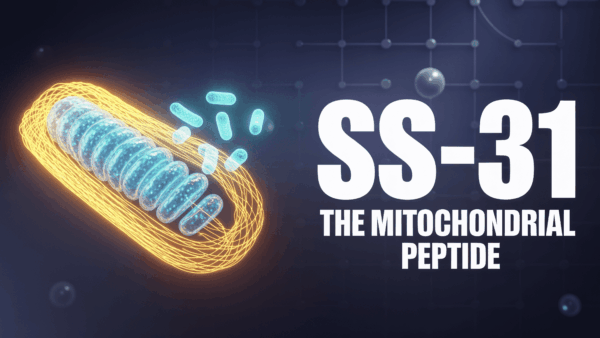
Almost every peptide in the longevity world lives in the same gray zone. Interesting mechanism, a pile of rodent studies, no regulatory validation, and a vendor page insisting it changes everything.
SS-31 is the exception. On September 19, 2025, the FDA approved this exact molecule as a prescription drug. Not a close analog. Not a derivative. The same tetrapeptide sold in research vials as SS-31 was approved under the brand name FORZINITY, making it the first mitochondria-targeted therapeutic ever cleared by the agency.
That fact is also where most SS-31 articles fall apart. The approval covers one ultra-rare genetic disease, in patients over 30 kilograms, on an accelerated pathway that still requires a confirmatory trial. It says nothing about fatigue, aging, or performance, and the research vial on a product page is not the pharmaceutical.
The real story is more interesting than the hype and more encouraging than the skeptics allow. SS-31 does something no supplement on your shelf does. It binds cardiolipin, a specific phospholipid in the inner wall of your mitochondria, and concentrates there roughly a thousandfold. That precision explains why it works when it works, and why several large trials still missed their targets.
This guide covers what SS-31 is, how the mechanism works in plain language, what the clinical trials showed including the failures, the dosing and reconstitution math, what people report week by week, how it compares to MOTS-c and NAD+, and where to source material worth putting in a syringe. Updated September 2026 with the NuPOWER results and the current regulatory picture.
Nearly half off everything at Everest Peptides
Everest Peptides' card processor is offline right now, so instead of waiting it out they're running a bank payment sale. Every peptide is 40% off, and code BRAINFLOW stacks another 15% at checkout. Pay with Zelle or Pay by Bank, same day shipping before 3pm ET, every batch third-party tested with the COA on the product page. Rated 4.9 on Trustpilot.
Shop the 40% off sale Code BRAINFLOW at checkout. Zelle and Pay by Bank only during the sale.What Is SS-31?
SS-31 is a synthetic peptide built from four amino acids. Four. In peptide terms that makes it a tetrapeptide, tiny next to BPC-157 at fifteen amino acids or TB-500 at forty-three.
The sequence is D-Arg-Dmt-Lys-Phe-NH2, and three features of it explain everything the molecule does.
The D-Arg is D-arginine, a mirror image of the normal amino acid. Your enzymes evolved to chew up the standard form, so flipping the stereochemistry makes the peptide far harder to degrade. The Dmt is 2,6-dimethyltyrosine, a modified tyrosine that scavenges reactive oxygen species right where they are produced. And the alternating pattern of positively charged and aromatic residues gives the molecule a net 3+ charge alongside a greasy face, the combination that lets it cross membranes and then stick hard to its target.
Molecular weight is about 640, formula C32H49N9O5, CAS number 736992-21-5 for the free base. Salt forms carry different CAS numbers, which is one reason vendor pages sometimes appear to disagree with each other.
The name comes from its inventors. Hazel Szeto at Weill Cornell and Peter Schiller at the Institut de recherches cliniques de Montréal developed a series of peptides together, and this was number 31 in the run. Szeto-Schiller peptide 31, shortened to SS-31.
The origin is a genuine accident of drug discovery. The Szeto-Schiller series began as opioid research, not mitochondrial research. The parent compound was a mu-opioid agonist, and moving the Dmt residue from position one to position two stripped out the opioid activity and left behind something with a completely different talent. It went straight to the mitochondria. Szeto founded Stealth BioTherapeutics in 2006 to develop it as a drug, and that company renamed itself Mighty Therapeutics in June 2026 after the approval.
Sorting out the naming is the single most useful thing this article can do for you, because the confusion around this compound costs people real money.
Every one of those names points at the same tetrapeptide. When a vendor page and a clinical trial appear to contradict each other, it is almost always because one says SS-31 and the other says elamipretide about the same molecule.
SS-31 vs Elamipretide: The Distinction That Costs People Money
Same molecule does not mean same product. Four tiers exist here, and collapsing them is the most common error online.
FORZINITY is a pharmaceutical manufactured under drug standards, supplied at 80 mg/mL in single-patient vials, prescribed for Barth syndrome. Compounded elamipretide is prepared by licensed pharmacies for physicians in some wellness practices. Clinical-trial elamipretide is what the published studies used. Research-grade SS-31 is a lyophilized powder sold for laboratory use, with quality that rests entirely on the vendor’s testing.
The chemistry is identical across all four. The manufacturing oversight, purity verification, sterility, and legal status are not. When someone writes “SS-31 is FDA-approved,” they are flattening four different things into one, and the difference matters more here than with almost any other peptide.
That fourth tier is the one most readers are buying, which makes the vendor’s testing the only quality control in the chain. Everest Peptides carries SS-31 in 10mg and 50mg, third-party tested by Freedom Diagnostics with the COA posted before you buy, and code BRAINFLOW takes 10% off.
How SS-31 Works (And the Number Everyone Gets Wrong)
Search SS-31 and you will see the same claim everywhere: it concentrates 1,000 to 5,000 times at the inner mitochondrial membrane. That upper number is wrong, and tracking down where it came from tells you something about how this compound gets written about.
The foundational 2004 paper in the Journal of Biological Chemistry is the source everyone cites. Its abstract says these peptides “concentrate 1000-fold in the IMM.” There is no 5,000 in it. The figure appears to have grown in later reviews and vendor copy, then got repeated until it looked like a fact. A thousandfold is still remarkable, and the real number does not need inflating.
The same paper gets misquoted a second way. People write that SS-31 uptake does not depend on mitochondrial membrane potential at all. What the researchers found was that collapsing the membrane potential reduced uptake by about 20%, so the accurate framing is that uptake is largely potential-independent, not entirely. That distinction still matters, because many mitochondria-targeted compounds ride the membrane charge to get inside, which means they work worst in the damaged mitochondria that need help most. SS-31 mostly sidesteps that problem. It does not sidestep it completely.
Cardiolipin, the Word That Explains the Rest
Your mitochondria produce roughly 90% of your body’s energy. The currency is ATP and the factory floor is the inner mitochondrial membrane, folded into dense pleats called cristae. Those folds pack in the machinery.
That machinery is the electron transport chain, a series of protein complexes passing electrons down a line like a bucket brigade. Each handoff pumps protons across the membrane and builds a charge gradient, which drives a molecular turbine called ATP synthase. Some electrons leak along the way, react with oxygen, and become reactive oxygen species. A little is normal signaling. Too much is oxidative stress.
Holding all of that in place is a phospholipid called cardiolipin, found almost exclusively in the inner mitochondrial membrane. Cardiolipin anchors the electron transport chain complexes, keeps them clustered into efficient supercomplexes, and gives the cristae their shape. Think of it as the structural wiring the entire power system is mounted on.
Cardiolipin is also unusually vulnerable. It sits directly beside where reactive oxygen species are generated, and its fatty acid tails oxidize easily. The molecule gets attacked by the very process it supports.
There is a destructive loop worth understanding. A protein called cytochrome c normally sits on cardiolipin doing its job as an electron carrier. Work published in Nature Chemical Biology showed that when cardiolipin oxidizes, cytochrome c changes character and behaves as a peroxidase, an enzyme that attacks cardiolipin further. Damaged wiring creates a saboteur that damages more wiring. That loop is implicated in aging, heart failure, kidney injury, muscle dysfunction, and neurodegeneration.
SS-31 interrupts it. Research in the Journal of the American Society of Nephrology found that SS-31 binds with high affinity to cardiolipin and that the resulting complex inhibits cytochrome c peroxidase activity by protecting its heme iron. Because cardiolipin lives almost nowhere else, binding it gives the peptide something close to a homing address.
What follows from that binding is a cascade rather than a single effect. Cristae structure stabilizes. The electron transport chain complexes stay organized, which improves electron flow and cuts leak. ATP output rises. Reactive oxygen species drop at the source instead of being mopped up afterward. The mitochondrial permeability transition pore, a stress-triggered channel that can push a cell toward apoptosis, becomes harder to open.
This is why “mitochondrial support” on a supplement label usually means nothing and SS-31 is different. Most compounds throw antioxidants at the general area or supply raw materials. SS-31 goes to the wiring and stabilizes it.
The caveat belongs here rather than buried at the bottom. An elegant mechanism is not a promise of outcomes. SS-31 does what the biochemistry says it does, and several large human trials still missed their endpoints. Both things are true, and the next section explains why.
BrainFlow’s pick for SS-31
Everest SS-31, tested before it ships
A peptide built to concentrate a thousandfold inside your mitochondria is not something to buy on trust. Everest runs every batch through Freedom Diagnostics, an independent US lab, and posts the Certificate of Analysis on the product page before you spend anything. Both vial sizes live on the same URL.
10mg vial
The cheap way to confirm the vial, the mix, and whether you notice anything at all. Two days of material at 5mg.
Most readers pick this
50mg vial
Ten days at 5mg instead of two. Same lab, same page, better cost per milligram, and no reconstituting every other morning.
Code BRAINFLOW takes 10% off either size. Sold for research use only.
SS-31 Benefits: What Holds Up and What Does Not
SS-31 has a stronger research backbone than most peptide trends because elamipretide went through real clinical trials with real monitoring. The open question was never whether the mechanism is interesting. It is which human outcomes are strong enough to matter.
Mitochondrial Energy and ATP Production
The core claim, and the best-supported one mechanistically. In isolated mitochondria and animal tissue, SS-31 consistently improves ATP output in cells that were struggling. The nuance that keeps getting dropped is that it does the most in dysfunctional mitochondria and comparatively little in healthy young ones. If your mitochondria are fine, there may not be much to fix. Evidence grade: strong preclinical, mechanistic in humans.
Aging and Age-Related Decline
The section biohackers care about most, and it deserves a straight treatment. The animal data is close to astonishing. A 2013 study in Aging Cell gave 27-month-old mice a single 3 mg/kg dose and found in-vivo mitochondrial coupling in aged muscle fully restored to young levels within one hour. Eight days of treatment increased whole-animal exercise tolerance. A follow-up in Free Radical Biology and Medicine gave 26-month-old mice eight weeks of SS-31 at 3 mg/kg daily, reversing age-related redox stress, increasing muscle mass, and improving treadmill endurance.
Now the part that gets left out of vendor copy. Both studies found little to no effect in young healthy animals, which is mechanistically logical and commercially inconvenient. And no completed human trial has ever used healthy aging, healthspan, or performance in healthy adults as an endpoint. Not one. Everything in the anti-aging conversation about SS-31 is extrapolated from rodents. Evidence grade: animal only.
Fatigue and Exercise Tolerance
Mechanistically this should work, and in aged mice it does. In humans the picture is muddier. The largest mitochondrial myopathy trial measured fatigue directly and found nothing at 24 weeks. Community reports describe a subtle cumulative lift rather than a stimulant effect. Evidence grade: animal only for performance, anecdotal in humans.
Barth Syndrome and Mitochondrial Disease
The strongest human evidence and the basis of the FDA approval. The detail matters enough that it gets its own section below. Evidence grade: approved on an intermediate endpoint, confirmatory trial pending.
Heart Health
Cardiac mitochondria are loaded with cardiolipin, and the preclinical data looked outstanding. Rabbit work published in the Journal of Cardiovascular Pharmacology and Therapeutics reported infarct size cut by roughly half when the peptide was given before reperfusion, though that figure held in large-risk-zone models and dropped to 10 to 20% in smaller ones. Then the human trials ran. PROGRESS-HF found no improvement in heart failure and EMBRACE-STEMI failed to reduce infarct size after heart attack. Evidence grade: animal promising, human trials negative.
Kidney Protection
One of the better early human signals, with a caveat about size. A phase 2a trial published in Circulation: Cardiovascular Interventions randomized 14 patients undergoing renal artery stenting, of whom six received elamipretide. Renal blood flow in the stenotic kidney rose from 202 to 262 mL/min three months after the procedure, and kidney function improved more in the treated group than in placebo. Six people is six people, but the direction is encouraging and deep animal data sits behind it. Evidence grade: preliminary clinical.
Eye Health and Dry AMD
Photoreceptors are among the most energy-hungry cells you own, so the mitochondrial angle is sensible. The ReCLAIM-2 trial randomized 176 patients and missed both primary endpoints, but the secondary results were interesting enough to change the development program. Progression of total ellipsoid zone attenuation, a retinal layer dense with mitochondria, fell 43%, and partial attenuation fell 47%. That endpoint is now the primary outcome in an ongoing phase 3 program. Evidence grade: mixed, with a real signal.
Claims worth refusing: that SS-31 treats neurodegeneration, reverses skin aging, fixes insulin resistance, or improves liver disease in humans. Those are mechanistic guesses and animal work, nothing more.
SS-31 Clinical Trials: The Wins and the Failures
Most SS-31 articles cite the wins and quietly skip the losses. That is a mistake, because the failures tell you more about who this compound helps than the successes do.
The Barth Syndrome Story
Barth syndrome is an ultra-rare genetic disease affecting roughly 150 people in the United States, almost all of them boys. The cause is a mutation in the tafazzin gene, and this is the part that matters for everything above: tafazzin is the enzyme that remodels cardiolipin. Barth syndrome is, at its root, a cardiolipin disease.
A cardiolipin-binding peptide is therefore more mechanistically justified here than anywhere else in medicine. This is SS-31 aimed at the precise problem it was built for.
The TAZPOWER trial enrolled twelve patients. Its randomized crossover portion failed both primary endpoints, which would normally end the story. The open-label extension told a different one. Results published in Genetics in Medicine reported cumulative six-minute walk improvement of 96.1 meters by week 168 with a p-value of 0.003, alongside gains in muscle strength measured by hand-held dynamometry at every visit. Ten patients entered the extension and eight reached week 168. The lesson appears to be that this drug needs a long runway, considerably longer than a standard trial window allows.
The FDA combined that extension data with a natural-history control study and granted accelerated approval on September 19, 2025, using muscle strength as the intermediate endpoint. A confirmatory trial is still required and accelerated approvals can be withdrawn if it fails. That confirmatory study began in the first half of 2026, and its design was presented at the Euromit conference in May 2026.
The Myopathy Trial That Failed, and What It Uncovered
MMPOWER-3 is the trial nobody quotes. It was the big one: 218 patients with primary mitochondrial myopathy, 24 weeks, 40 mg daily. Published in Neurology, it missed both co-primary endpoints. The six-minute walk difference was negative 3.2 meters with a p-value of 0.69, and the fatigue score showed nothing at 0.37. The paper carries Class I evidence that elamipretide does not improve those outcomes at 24 weeks in that population.
Something more useful was buried in the data. A post hoc analysis in the Orphanet Journal of Rare Diseases split patients by genotype and found the nuclear DNA cohort of 59 patients improved 25.2 meters against 0.3 meters on placebo, with a p-value of 0.03. Narrowing further to patients with replisome variants and CPEO produced the sharpest result in the entire program: a mean gain of 37.3 meters against a loss of 8.0 meters on placebo, p equal to 0.0024, in 14 people.
That finding drove the phase 3 NuPOWER trial in patients with nuclear DNA mutations, and the company reported in 2026 that NuPOWER showed a genotype-dependent response in the POLG1 subgroup, which is now the basis for a targeted development program. Failed trials with a live subgroup are how drug development usually works, and pretending the failure did not happen helps nobody.
The pattern across the whole program is worth naming plainly. SS-31 performs best where mitochondrial dysfunction is the primary driver of disease, where the genotype matches the mechanism, and where you give it enough time. It underperforms in acute settings and in mixed populations. That is a coherent story rather than a failed compound.
SS-31 Dosage and Reconstitution
This is the section people search for. What follows summarizes what clinical trials used, what the FDA label specifies, what preclinical work used, and what communities discuss. It is informational rather than a personal recommendation, and none of it is approved dosing outside Barth syndrome.
The number to know is 40 mg. That dose runs through MMPOWER-2, MMPOWER-3, TAZPOWER, and ReCLAIM-2 as a once-daily subcutaneous injection, and it is also the FORZINITY label dose for patients over 30 kilograms. When trials wanted intravenous delivery, as in the heart and kidney studies, they used roughly 0.05 mg/kg per hour by infusion.
Notice the gap in that table. Community protocols run far below the 40 mg used in every human trial, and no study has validated those lower doses for anything. People landed there through cost, caution, and copying each other. That is not a criticism so much as a fact worth knowing before assuming online protocols are evidence-based.
Reconstitution Math That Does Not Wreck the Dose
Vial size is not the dose. Mix a 10mg vial and a 50mg vial with the same volume of bacteriostatic water and you have two completely different concentrations. This produces most of the dosing errors people make with SS-31, and the peptide has nothing to do with it.
What goes on the bench: bacteriostatic water, a U-100 insulin syringe where 100 units equals 1.0 mL, a 30 or 31 gauge needle, and site rotation. Aim the water down the glass wall rather than blasting the powder cake, then roll the vial gently. Shaking produces foam and can damage the peptide.
The trap in that table is the one people fall into constantly. Forum math like “20 units is 1 mg” only holds if you mixed your vial exactly the way they mixed theirs. On a 50mg vial with 2.0 mL of water, 20 units is 5 mg, a fivefold difference. Write the concentration on the cap the day you reconstitute, because you will not remember on day nine.
This is also the practical argument for the larger vial. Every reconstitution is a fresh chance to get the math wrong, and a 50mg vial from Everest at 25 mg/mL holds a steady 20 units per 5 mg for ten days instead of two. Fewer mixes, fewer opportunities to misdose, and code BRAINFLOW saves 10%.
Route matters too. Subcutaneous injection is the dominant route in trials and in practice. Oral SS-31 has no meaningful human efficacy evidence, which is unsurprising given what digestion does to peptides, and nasal has none either. A vendor selling oral SS-31 with injection-level promises is making a claim nothing supports.
Community timing leans toward morning dosing, with cycles typically running 8 to 12 weeks. Trials dosed continuously rather than cycling, so the 5-on/2-off convention is a community habit rather than a research finding. Store lyophilized vials cold and dark. Once mixed, refrigerate and treat 28 days as the conservative working window. For reference, the FORZINITY label instructs patients to discard the pharmaceutical vial 8 days after first opening.
What to Expect on SS-31, Week by Week
The pattern below is drawn from peptide and longevity community reports rather than trial endpoints. It is useful mainly so you do not throw the vial out on day four because it did not feel like caffeine.
The first few days are usually quiet apart from the injection site. Redness, itching, or a small lump are all common. Anyone who feels wired or stimulated in that window should be more curious about what else is in the vial, because that is not how SS-31 announces itself.
Week two stays quiet for most people. A few logs mention the second training session of the day hurting less. Plenty mention nothing at all, and both are normal.
Weeks three and four are where the reports start stacking up. The most common description is having a bit more in the tank rather than any dramatic shift, with late-day mental fatigue easing off and gym recovery coming faster.
Weeks six through eight should be treated as the actual test. The Barth data took months to look good, and the extension results that eventually won an FDA approval accumulated over years. Two weeks is a mood. Eight weeks is closer to an answer.
Most community cycles stop somewhere between weeks eight and twelve. Trials did not cycle at all, they simply kept dosing. If nothing has happened by week eight, stacking MOTS-c and NMN on top is unlikely to reveal anything the peptide was not already doing.
A meaningful share of people feel nothing, and that is not a mystery. The mechanism predicts it. If the wiring is not damaged, a cardiolipin binder has no job to do. Younger readers who already sleep, train, and eat well should expect the smallest effect rather than the highlight reel, which is exactly what the mouse studies found when they tested young animals.
SS-31 Side Effects and Safety
The safety picture is one of the better arguments for SS-31, and it is unusually well documented because the compound went through real trials with real monitoring.
Injection-site reactions dominate, and the numbers are striking. In the Barth crossover study every single patient on elamipretide had a local reaction, with injection site erythema at 100% versus 25% on placebo, induration and itching at 67%, and pain at 75%. These were mild to moderate and manageable with site rotation, but anyone expecting a clean daily injection should recalibrate.
The FORZINITY label notes increases in absolute eosinophil counts, a type of white blood cell, occurring frequently when dosing ran 30 days or longer. Counts peaked around 90 days and returned to baseline within 6 to 12 months. It is usually asymptomatic, though it is worth knowing about before a long run.
Two formal warnings sit on the label. Hypersensitivity reactions, including serious allergic reactions requiring emergency intervention, have been reported anywhere from minutes to months after starting. And the pharmaceutical contains benzyl alcohol, making it inappropriate for neonates.
The reassuring data comes from MMPOWER-3. Across 218 patients over 24 weeks there were no deaths and no hospitalizations attributed to the drug, with 94% of participants completing the study. Discontinuation for adverse events ran 7.3% on elamipretide against 1.8% on placebo. For a daily injectable, that is a clean record.
The bigger risk for most readers is not the peptide. It is the vial. Research-grade material carries risks that trials do not, including wrong identity, wrong concentration, endotoxins, poor sterility, and degradation from bad storage or shipping. A compound engineered to concentrate a thousandfold inside your mitochondria is not something you want contaminated. Buying from a vendor with third-party testing and a posted Certificate of Analysis is the highest-leverage safety decision available here.
Who Should Avoid SS-31
- Pregnant or breastfeeding, since no safety data exists for these populations
- Children and adolescents outside the approved Barth indication
- Anyone with a history of severe allergic reactions to peptide therapies, given the hypersensitivity warning on the label
- Tested athletes, who should verify status with their governing body before using any injectable performance-adjacent peptide
- Anyone on a treatment plan for a diagnosed condition, since SS-31 does not replace approved medical care and the interaction data does not exist
Theoretical concerns about cancer and mitochondrial overstimulation circulate online. Neither has been demonstrated in the trial record in either direction, which means the honest answer is that nobody knows.
Is SS-31 Legal in 2026?
In the United States, elamipretide is FDA-approved as FORZINITY for Barth syndrome in patients weighing at least 30 kilograms, granted September 19, 2025 under accelerated approval. It holds Orphan Drug, Fast Track, Priority Review, and Rare Pediatric Disease designations. The path was not smooth. The FDA issued a Complete Response Letter first, and an advisory committee vote preceded the eventual approval.
The drug reached the market in late November 2025 and had its formal commercial launch in the second quarter of 2026. Mighty Therapeutics, the renamed Stealth BioTherapeutics, is running the required confirmatory trial alongside programs in polymerase gamma mitochondrial disease and a phase 3 dry AMD study that reads out in late 2027.
That single indication is the entire scope of approval anywhere in the world. SS-31 is not approved for mitochondrial disease generally, fatigue, aging, heart disease, kidney injury, eye disease, or performance. In the EU, elamipretide holds an orphan designation for Barth syndrome granted in 2021, which is a development incentive rather than a marketing authorization. The UK, Canada, and Australia have no approval on record.
Research-grade SS-31 is sold for laboratory use only. It is not an approved drug and not a dietary supplement ingredient, so it cannot be legally marketed for human treatment. Selling it with claims about energy, aging, or performance is precisely what the FTC exists to punish.
One clarification that saves confusion: SS-31 was not part of the FDA’s 503A compounding review that covered BPC-157, TB-500, KPV, and MOTS-c in July 2026. Because elamipretide is an approved drug, it sits on a completely different regulatory track from those research peptides, and the compounding debate does not apply to it in the same way.
Four phrases people treat as synonyms and should not: available online, legal to possess, FDA-approved, and clinically proven. SS-31 occupies an unusual position where the molecule is truly approved for one disease while the product most people buy is none of those other things.
SS-31 vs MOTS-c, NAD+, CoQ10, and MitoQ
Everything in the mitochondrial aisle claims to support your mitochondria. They are not doing the same job, and the differences become obvious once you know what each one targets.
The cleanest way to hold it in your head: NAD+ precursors supply fuel for the reactions, CoQ10 and MitoQ manage electrons and oxidation, PQQ nudges you to build more mitochondria, and creatine buffers ATP outside the mitochondria entirely. SS-31 is the only one repairing the structural wiring the whole system is mounted on, and the only one whose molecule cleared the FDA.
Stacking SS-31 With Other Peptides
What follows describes what people do rather than recommending it. The honest headline is that not one of these combinations has a human trial behind it.
The most popular pairing is SS-31 with MOTS-c, usually framed as hardware plus software, where one repairs membrane structure and the other signals metabolic adaptation. After that come the mitochondrial support stacks, SS-31 alongside NAD+ precursors, CoQ10, PQQ, or MitoQ, on the logic that fixing the wiring works better when the coenzymes and electron carriers are topped up. Some people add creatine for ATP buffering.
The caution applies to all of them equally. Stack four mitochondrial compounds at once and you will never learn which one did anything, and if something goes wrong you will not know what caused it. Running it alone for a cycle first is the only way to get a clean read. And no stack outruns bad sleep and no training.
What SS-31 Users Report
Anecdotal, drawn from peptide and longevity communities, and not evidence. It is still useful for setting expectations.
The most consistent theme is that SS-31 is not a stimulant and does not feel like one. People describe a slow cumulative lift in baseline energy noticed around week three or four rather than day one. The two most-reported wins are faster recovery between training sessions and better cognitive stamina deep into long work. Nobody describes a rush.
The other side is equally consistent. A meaningful share of people report nothing at all, which lines up with the mechanism, and injection-site irritation is the common complaint. Community consensus holds that sourcing is the biggest variable in whether anyone gets anything from it.
One filter to read threads with: forums constantly confuse SS-31 with pharmaceutical elamipretide and treat the Barth approval as blanket validation for running 5 mg a day for energy. Those are different claims resting on different evidence.
Where to Buy SS-31
SS-31 sits in research-compound territory, which means the vendor performs the quality control a pharmacy would otherwise handle. No regulator stands between you and a bad vial.
What to demand: independent third-party testing from a named lab, a Certificate of Analysis visible before purchase, clearly stated vial contents in milligrams, proper cold-chain handling, and a vendor with a traceable track record. Red flags: no COA, a COA that does not match your batch, vague sourcing answers, oral SS-31 sold with injection-level promises, and any seller marketing it as a treatment for a disease.
We point BrainFlow readers to Everest Peptides for SS-31. Their material is third-party tested by Freedom Diagnostics, an independent US lab you can look up, with the Certificate of Analysis posted so you can verify identity and purity before buying rather than hoping afterward. They ship same-day from inside the US, so there are no customs delays.
Worth knowing for anyone running more than a sample: Everest carries SS-31 in both 10mg and 50mg on the same product page. The 10mg makes sense for a first look, confirming how the vial behaves and whether you notice anything at all. The 50mg is the one that matches the 5 to 10 mg daily math without reconstituting every other morning. Run 5 mg daily for eight weeks and you need 280 mg, which is twenty-eight small vials or six of the larger ones.
The testing is why we recommend them rather than the price. With a peptide built to concentrate a thousandfold inside your mitochondria, probably fine is not an acceptable standard for what is in the vial.
Do the math before you buy
An 8-week run needs 280mg. Buy accordingly.
At 5mg a day, eight weeks is 280mg of material. That is twenty-eight 10mg vials, or six 50mg vials with some left over. Same Freedom Diagnostics testing on both, same COA posted before checkout, same product page. The only thing that changes is how many mornings you spend mixing.
Still deciding
Start with 10mg
Smaller check. Confirm the COA, the reconstitution, and whether anything happens at all.
Running a real cycle
Go straight to 50mg
Six vials covers the whole eight weeks. Better cost per milligram, and the concentration stays put once you write it on the cap.
Code BRAINFLOW takes 10% off the 10mg or the 50mg. Sold for research use only.
SS-31 FAQ
Is SS-31 FDA approved?
The molecule is, under the name FORZINITY, approved September 19, 2025 for Barth syndrome in patients over 30 kilograms. That is the only approval anywhere in the world. SS-31 is not approved for aging, fatigue, performance, heart disease, or eye disease, and research-grade SS-31 sold online is not the approved pharmaceutical.
What is the difference between SS-31 and elamipretide?
They are the same molecule. SS-31 is the research name, elamipretide is the pharmaceutical name, and MTP-131 and Bendavia are older development codes. What differs is manufacturing standards, testing, and legal status, not chemistry.
Does SS-31 really concentrate 5,000 times in mitochondria?
No. The 2004 Journal of Biological Chemistry paper that everyone cites reports roughly 1,000-fold concentration at the inner mitochondrial membrane. The 5,000 figure appears in later reviews and vendor copy but not in the original research. A thousandfold is still extraordinary for a compound you inject under the skin.
What is the standard SS-31 dosage?
Every major human trial and the FDA label use 40 mg once daily by subcutaneous injection. Community protocols typically run much lower, around 5 to 10 mg daily, with no trial data supporting those doses.
How do I reconstitute a 50mg SS-31 vial?
A common mix is 2.0 mL of bacteriostatic water into the 50mg vial, giving 25 mg/mL. On a U-100 syringe that makes 5 mg equal to 20 units and 10 mg equal to 40 units. Write the concentration on the cap, and never reuse a 10mg unit chart on a 50mg vial.
How long does SS-31 take to work?
In aged mice, mitochondrial coupling improved within an hour of a single dose. In humans, community reports describe a cumulative effect noticed around three to four weeks, and the Barth trial data suggests the real gains took months to accumulate.
Does SS-31 work for anti-aging?
In aged mice, impressively so. In humans, no completed trial has ever tested healthy aging or performance as an endpoint, so anyone claiming proof is extrapolating from rodents. The same studies also found almost nothing in young healthy animals.
Why did the SS-31 heart trials fail?
PROGRESS-HF ran 71 patients for four weeks and found no improvement in heart volume measures, and EMBRACE-STEMI enrolled 118 patients and failed to reduce infarct size. The pattern across the program suggests SS-31 needs time and a population where mitochondrial dysfunction is the primary driver, neither of which an acute cardiac setting provides.
Is SS-31 safe?
Trial safety has been good, with no deaths or hospitalizations across 218 patients in the largest study. Injection-site reactions are close to universal with daily dosing, and the label notes raised eosinophil counts past 30 days that resolve on their own. Long-term safety at the lower doses people tend to run is unknown, and product quality is the bigger practical risk with research-grade material.
Can I take SS-31 orally?
No meaningful human efficacy evidence exists for oral SS-31. Trials used subcutaneous injection or IV infusion. Treat an oral product page as a different claim than the research described here.
SS-31 vs MOTS-c, which is better?
They do different jobs. SS-31 repairs mitochondrial membrane structure and has real clinical trials behind it. MOTS-c is a signaling peptide affecting metabolic pathways with mostly preclinical data. Neither replaces the other, and the two are commonly run together.
Where can I buy SS-31?
BrainFlow points readers to Everest Peptides SS-31, third-party tested by Freedom Diagnostics with the Certificate of Analysis posted before purchase. Both 10mg and 50mg sit on the same page, and code BRAINFLOW takes 10% off either size.
Final Verdict on SS-31
SS-31 is the most mechanistically precise peptide in the longevity world, and the only one whose molecule carries an FDA approval. Those two facts put it in a category of one. A compound that concentrates a thousandfold at a single membrane and repairs the specific lipid organizing your energy machinery is not doing “mitochondrial support.” That is engineering.
The trial record is more complicated than the marketing. Several large studies missed their endpoints. The approval is narrow and conditional. Nobody has tested this in healthy people for energy or performance, and the animal work that excites everyone showed the biggest effects in old animals and almost nothing in young ones.
What emerges is a compound with a real future and a specific profile. The failures were not random. SS-31 works where mitochondrial dysfunction drives the problem, where the genotype matches the mechanism, and where it gets enough time, which is exactly what the Barth extension and the POLG1 subgroup both demonstrated. If your mitochondria are struggling, it is aimed at the actual problem in a way nothing on a supplement shelf is. If everything is running fine, expect less.
The people reporting the best results are running it long enough to matter and sourcing material they can verify. If you decide to run it, get it somewhere that proves what is in the vial. Everest Peptides SS-31 is third-party tested by Freedom Diagnostics with a posted COA in both 10mg and 50mg, and code BRAINFLOW takes 10% off either size. With a peptide this targeted, knowing exactly what you are injecting is not optional.
SS-31 is not FDA-approved for any indication other than elamipretide (FORZINITY) for Barth syndrome. All information here is for educational and research purposes only and is not medical advice.
SS-31 is sold as a research compound for laboratory use only. Consult a qualified healthcare provider before beginning any protocol.
This article contains affiliate links. BrainFlow may earn a commission on qualifying purchases at no additional cost to the reader. We only recommend sources we trust.