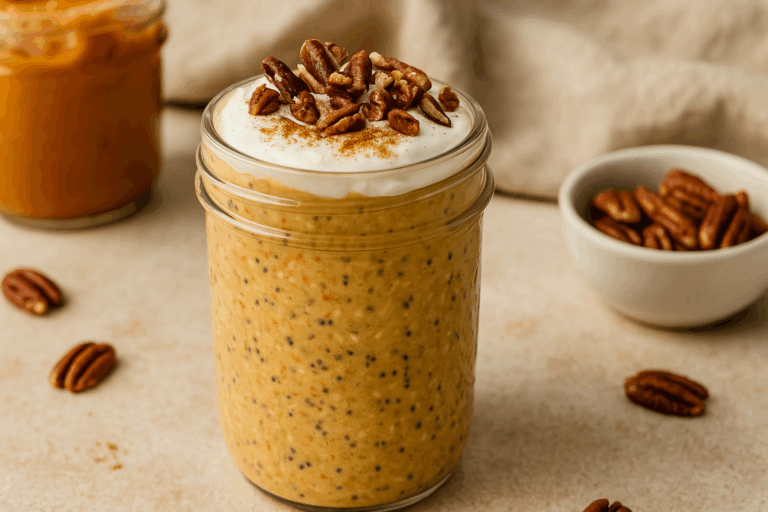
High-Protein Pumpkin Pie Overnight Oats Recipe (That Actually Tastes Like Fall)

Listen, I’m about to solve your entire morning routine with one jar and zero effort. These pumpkin pie overnight oats pack 25 grams of protein and taste like you raided a bakery at 3 AM โ€“ except you made them in your pajamas last night while watching Netflix.

If you’re the type who sets seventeen alarms and still manages to run out the door with mismatched shoes and yesterday’s dry shampoo, this recipe is your new best friend. It’s meal prep for people who think meal prep is buying a family-size bag of chips “for the week.”

Why You’ll Love This Recipe (Besides the Obvious “It’s Delicious” Part)

  • 25g of protein โ€“ More muscle-building power than your ex’s excuses
  • 5-minute prep time โ€“ Literally faster than deciding what to watch on Netflix
  • Tastes like dessert โ€“ But makes you feel like a responsible adult
  • No cooking required โ€“ Your smoke alarm can finally relax
  • Perfect for meal prep โ€“ Make Sunday night, eat smugly all week
  • Instagram-worthy โ€“ Because if you didn’t post it, did you even eat breakfast?

The Real Talk About Why This Recipe Exists

Look, we’ve all been there. It’s October, everything smells like cinnamon, and suddenly you’re spending $7 on a pumpkin spice latte that has the protein content of a sad lettuce leaf. Meanwhile, your fitness app is passive-aggressively reminding you about your protein goals.

Enter these overnight oats โ€“ the hero we deserve. They’re basically autumn in a jar, but instead of leaving you hungry an hour later, they keep you full until lunch. Revolutionary? Maybe not. Life-changing for your morning routine? Absolutely.

Ingredients You’ll Need (And What They’re Actually Doing)

The Main Players:

  • 1/2 cup rolled oats โ€“ Not the instant kind. We’re not savages. Old-fashioned oats give you that perfect creamy-but-not-mushy texture that makes you feel like you have your life together. You can grab good oats at any grocery store, but I use Bob’s Red Mill because I’m fancy like that.
  • 3/4 cup unsweetened almond milk โ€“ Or whatever milk doesn’t make your stomach angry. Oat milk works great if you want to go full meta with your oats-on-oats action.
  • 1/2 cup pumpkin puree โ€“ The canned stuff. And for the love of all that is holy, make sure it says “pumpkin puree” not “pumpkin pie filling.” That’s a different party with uninvited sugar guests.
  • 1 scoop vanilla protein powder โ€“ This is where the magic happens. I recommend Orgain Organic Protein Powder in Vanilla because it’s creamy, actually tastes like vanilla (not sadness), and doesn’t have that weird chalky aftermath. Plus it’s organic, so you can feel extra virtuous about your breakfast choices.
  • 1 tablespoon chia seeds โ€“ These little guys expand overnight like your jeans after Thanksgiving. They add thickness, omega-3s, and make you feel fancy. I swear by Navitas Organics chia seeds โ€“ one bag lasts literally forever.

The Flavor Squad:

  • 1-2 teaspoons maple syrup โ€“ Optional, but recommended if you have a soul
  • 1/2 teaspoon pumpkin pie spice โ€“ The reason we’re all here
  • 1/4 teaspoon cinnamon โ€“ Because more is more when it comes to fall spices
  • Pinch of salt โ€“ Makes everything else taste better, like a good friend who hypes you up

Step-by-Step Instructions (So Easy, You Can Do It Half-Asleep)

  1. Grab a jar or bowl โ€“ Mason jars make you look Pinterest-perfect (these Ball jars are the holy grail), but a regular container works if you’re not trying to impress anyone. Who are we kidding? Use the jar.
  2. Dump everything in โ€“ Oats, milk, pumpkin, protein powder, chia seeds, maple syrup, and all the spices. This isn’t fancy French cooking; it’s overnight oats. Precision is optional.
  3. Stir like you mean it โ€“ Make sure that protein powder is fully mixed in. Nobody wants surprise powder pockets in the morning. It’s like finding a plot hole in your favorite show โ€“ disappointing and preventable.
  4. Cover and refrigerate โ€“ Let it sit overnight, or at least 4 hours if you’re impatient. The fridge does all the work while you sleep. It’s basically the slow cooker of breakfast.
  5. Morning magic โ€“ Give it a stir, add your toppings, and pretend you meal-prepped like an influencer.

Recipe Tips & Variations (For When You’re Feeling Adventurous)

The “I Ran Out of Protein Powder” Panic Fix:

Swap in 1/2 cup of Greek yogurt. It won’t give you quite as much protein, but it’ll still beat that granola bar you were considering.

The Sweet Tooth Situation:

Add another teaspoon of maple syrup, a dash of vanilla extract, or โ€“ if you’re feeling wild โ€“ a handful of mini chocolate chips. We don’t judge here.

The Texture Perfectionist Guide:

  • Like it thicker? Add more chia seeds or reduce the milk slightly
  • Prefer it creamier? Add an extra splash of milk in the morning
  • Want some crunch? Top with toasted pecans, pepitas, or granola

The “Make It Fancy” Toppings Bar:

  • Crushed pecans (classic and classy)
  • A dollop of Greek yogurt (protein on protein action)
  • Sprinkle of cinnamon (because you can never have too much)
  • Drizzle of almond butter (go ahead, you deserve it)
  • Fresh apple slices (for that apple pie crossover episode)

Storage Instructions (AKA How Long Can I Ignore These in My Fridge?)

These babies stay fresh for up to 4 days in the fridge, making them perfect for meal prep Sunday. Just make 4 jars, line them up in your fridge, and feel superior to everyone buying breakfast all week.

Pro tip: They’re best enjoyed cold, but if you’re a warm breakfast person, microwave for 30-45 seconds. Just don’t blame me if your coworkers get jealous of the pumpkin spice aroma wafting from the break room.

Nutrition Info (The Numbers That Actually Matter)

Per serving:

  • Calories: 340 (Worth every single one)
  • Protein: 25g (Your muscles are already thanking you)
  • Carbs: 38g (The good kind that fuel your day)
  • Fat: 9g (Keeping you satisfied)
  • Fiber: 9g (Your digestive system’s best friend)

FAQs (Because I Know You’re Wondering)

Can I use regular milk instead of almond milk?
Absolutely! Use whatever milk makes your heart sing. Dairy milk will add even more protein. Win-win.

What if I hate chia seeds?
First of all, how dare you. Second, just leave them out. The oats will be slightly less thick, but still delicious.

Can I make these warm from the start?
You could, but then they’re just regular oatmeal with commitment issues. The overnight magic is what makes them special.

Is this actually filling?
With 25g of protein and 9g of fiber? You’ll be full until lunch, maybe even until that 3 PM snack attack.

Can I use pumpkin pie filling instead?
Only if you want dessert for breakfast. Which, honestly, I respect. Just know you’re adding a ton of sugar.

The Bottom Line (Your TLDR Moment)

If you’re tired of sad desk breakfasts and want something that tastes like fall threw a party in your mouth while still hitting your protein goals, these overnight oats are your answer. They take 5 minutes to make, taste like pie, and make you feel like you have your life together โ€“ even if you definitely don’t.

Make a batch Sunday night, and Monday-morning-you will be forever grateful. Plus, when Karen from accounting asks what smells so good, you can casually mention you “meal prep now” and watch her mind explode.

The 5 Best Skincare Products You Actually Need After 40 (I Tested Everything)

0

If you’re anything like me, hitting your 40s felt like your skin suddenly decided to play by completely different rules. One day you’re coasting along with your same old routine, and the next you’re staring in the mirror wondering when those little lines decided to set up permanent residence. Sound familiar? Don’t worry, you’re not alone โ€“ and I’ve got some game-changing discoveries to share with you!

After tons of trial and error (and yes, more money than I care to admit spent on products that didn’t deliver), I’ve finally cracked the code on what actually works for our skin at this stage of life. So grab your coffee, get comfy, and let’s chat about the products that have genuinely transformed my skin โ€“ and can do the same for yours.

My Top 5 Must-Have Skincare Products for Fabulous 40s

Listen, I know the skincare aisle can feel overwhelming โ€“ trust me, I’ve spent way too many hours there myself! But here’s the thing: once you find what really works, your routine becomes so much simpler and more effective. These are the products that have earned permanent spots on my bathroom counter.

1. Renue Blue Face Serum by Renue by Science (My Absolute Holy Grail!)

Okay ladies, I need to tell you about the product that literally changed everything for me โ€“ the Renue Blue Face Serum. I’m not even exaggerating when I say this serum has become my desert island skincare pick. If I could only use one anti-aging product for the rest of my life, this would be it, hands down.

I discovered Renue Blue Face Serum about a year ago when a friend couldn’t stop raving about how it transformed her skin. I was skeptical (aren’t we always?), but when she showed up to brunch looking like she’d had a professional facial every day for a month, I had to know her secret. That’s when she introduced me to this little blue miracle.

What makes Renue Blue Face Serum so special? It’s all about the science, but don’t worry โ€“ I’ll keep it simple! This serum contains FOUR TIMES the amount of methylene blue compared to other formulas (yes, it has a slight blue tint, which honestly makes me feel like I’m using something from the future). It’s combined with their NAD+ Complex โ€“ that’s NAD+, NMN, and NR all working together. These ingredients literally work at the cellular level to help your skin cells act younger. It’s like giving your skin cells a pep talk and an energy drink all at once!

When I first started using it, I noticed my skin felt different within just a few days โ€“ smoother, more hydrated, and somehow just… happier? But the real magic happened around week three. My husband actually asked if I’d gotten “something done” because my skin looked so much brighter and firmer. Those stubborn lines around my eyes? Softened significantly. The texture issues on my cheeks? Practically disappeared. Even my neck (you know, the area that likes to betray our age first) started looking tighter and more youthful.

The best part? This serum uses advanced nanoliposome technology, which basically means it penetrates way deeper than regular serums. These tiny liposomes are like microscopic delivery bubbles that merge with your skin cells and deliver the ingredients exactly where they’re needed. So instead of just sitting on top of your skin looking pretty, it’s actually getting down to business where it counts. Plus, it’s packed with antioxidants like glutathione and apocynin that protect your skin from all the environmental nasties we face daily, and alpha-lipoic acid (ALA) for extra anti-inflammatory benefits.

I use it every morning and evening after cleansing โ€“ just one to two pumps pressed gently into my face, neck, dรฉcolletage, and even my hands (because why should they miss out?). It absorbs beautifully and doesn’t leave any sticky residue. Sometimes I follow it with the Renue Blue Face Cream for extra moisture as part of their 2-step protocol, but honestly, the serum alone is incredibly hydrating thanks to the hyaluronic acid that can hold 1,000 times its weight in water!

Pro tip: You can save 10% on your Renue Blue Face Serum order using code BRAINFLOW โ€“ you’re welcome! ๐Ÿ˜Š At $64.95 a bottle (or just $58.46 with their subscribe & save option), it’s actually more affordable than many department store serums that don’t deliver half the results. Plus, it’s fragrance-free and made with non-GMO ingredients, so even my sensitive-skin friends love it. Trust me, your skin will thank you!

RELATED READING: Harvard Scientist David Sinclair Reveals His Anti-Aging Supplement Stack

2. Vitamin C (Your Morning Glow-Getter)

If Renue Blue is my skincare soulmate, then Vitamin C serum is definitely my morning bestie. Seriously, starting my day without it feels like leaving the house without my coffee โ€“ technically possible, but why would I do that to myself?

Here’s what I love about Vitamin C: it’s like a little shot of sunshine for your face (in the best way possible). After incorporating it into my morning routine, people started asking if I’d been on vacation because I looked so “rested” and “glowy.” Ha! If only they knew it was just my trusty Vitamin C doing its thing.

The science-y bit (I’ll keep it quick): Vitamin C is a powerhouse antioxidant that fights off free radicals, boosts collagen production, and helps fade those annoying dark spots that seem to multiply after 40. It’s basically like having a tiny army protecting your skin all day long.

When I first started using Vitamin C, I made the rookie mistake of going straight for a 20% concentration. Big mistake! My sensitive skin was not happy. So here’s my advice: start with 10% and work your way up. Your skin will thank you for the gentle introduction.

My current favorite is Paula’s Choice C15 Super Booster โ€“ it’s the perfect strength for daily use without irritation, and it plays nicely with my other products. I apply it right after my Renue Blue in the morning, wait a minute for it to absorb, then follow with moisturizer and SPF. The combination of Renue Blue and Vitamin C? *Chef’s kiss* โ€“ it’s like they were made for each other!

One thing nobody tells you: Vitamin C can go bad (it turns yellow or brown when it oxidizes), so store it in a cool, dark place. I keep mine in my bedroom drawer instead of the steamy bathroom โ€“ learned that one the hard way!

3. The Dynamic Duo: Retinol & Peptides

Okay, I’m cheating a little by combining these two, but hear me out โ€“ retinol and peptides together are like the power couple of anti-aging. Think of them as the Beyoncรฉ and Jay-Z of skincare (too much? Never!).

Let’s Talk Retinol First

Retinol was my gateway drug into serious skincare, and wow, what a game-changer! If you’re new to retinol, think of it as that friend who tells you the truth even when you don’t want to hear it โ€“ a little harsh at first, but ultimately exactly what you need.

When I hit 42, I noticed my skin texture was just… off. Nothing dramatic, but those pores seemed bigger, and my complexion looked a bit dull. Enter retinol! This vitamin A derivative basically tells your skin cells to speed up their turnover, revealing fresh, glowy skin underneath.

Fair warning: the first few weeks can be rough. I experienced what I now lovingly call “the retinol uglies” โ€“ some peeling, redness, and my skin felt a bit sensitive. But girlfriend, push through! By week four, my skin was smoother than it had been in years. Those fine lines around my mouth? Softened. Dark spots from too many beach vacations in my 30s? Fading fast.

Start slow โ€“ twice a week at first, then gradually increase. And please, PLEASE wear sunscreen during the day (more on that later). CeraVe’s Resurfacing Retinol Serum is perfect for beginners at just $12 โ€“ no need to break the bank!

Now, Let’s Add Peptides to the Mix

If retinol is the tough love friend, peptides are the supportive bestie who’s always building you up. These little protein fragments boost collagen production and help your skin stay firm and bouncy โ€“ you know, like it used to be naturally (remember those days?).

What I love about peptides is that they’re gentle enough to use with retinol, and they actually help counteract some of retinol’s drying effects. It’s like they’re the peacemaker in your skincare routine, making sure everyone plays nicely together.

My peptide favorites that won’t break the bank:

Pro tip: I use peptides in the morning (they layer beautifully under makeup) and retinol at night. This way, they each get their moment to shine without competing for attention!

RELATED READING: 5 Ways to Boost NAD Levels Naturally

4. Daily Moisturizer (Because Hydration is Everything)

Ladies, can we talk about how our skin’s thirst level after 40 is like that friend who always wants to stop for drinks? It’s constant! But here’s the thing โ€“ the right moisturizer can be the difference between looking dewy and fresh versus looking like you’re wearing yesterday’s makeup (even when you’re not).

Daytime Moisture Magic

Your morning moisturizer needs to be like a good bra โ€“ supportive, comfortable, and makes everything look better. I need something that hydrates without making me look shiny by noon, protects from pollution, and plays well with makeup.

My ride-or-die is CeraVe AM Facial Moisturizing Lotion. It has SPF 30 (multitasking for the win!), ceramides to repair your skin barrier, and it never pills under makeup. Plus, it’s available at every drugstore, so no excuses!

For those days when my skin feels extra parched (hello, winter!), I reach for Neutrogena Hydro Boost Water Gel. It’s like giving your skin a tall glass of water โ€“ instant relief without the heaviness.

Nighttime Restoration Station

Nighttime is when the magic happens, girls! While you’re dreaming about your next vacation (or in my case, a full night’s sleep), your skin is busy repairing itself. Give it the good stuff!

I’m obsessed with Olay Regenerist Night Recovery Cream. It’s rich without being greasy, and I swear I wake up looking five years younger. The peptides work overnight to plump everything up โ€“ it’s like a facial while you sleep!

For sensitive skin nights (we all have them), La Roche-Posay Toleriane Ultra Night is my go-to. It’s like wrapping your face in a cashmere blanket โ€“ so soothing and gentle.

And when I want to wake up glowing? RoC Retinol Correxion Deep Wrinkle Night Cream combines retinol with intense moisture. Just remember โ€“ if you’re already using a retinol serum, skip this to avoid overdoing it!

5. Sunscreen (Your Future Self Will Thank You)

I know, I know โ€“ sunscreen isn’t sexy. But you know what is? Looking fabulous at 50, 60, and beyond! If I could go back and tell my 20-year-old self one thing, it would be “WEAR SUNSCREEN EVERY SINGLE DAY!” (Okay, and maybe “don’t date that guy from the gym,” but mostly the sunscreen thing).

Here’s the truth bomb: 90% of skin aging comes from sun damage. NINETY PERCENT! So while we’re spending money on all these amazing treatments, skipping sunscreen is like leaving your expensive handbag out in the rain. Why would you do that?

My Sunscreen Squad:

  1. EltaMD UV Clear SPF 46 โ€“ This is the Hermรจs of sunscreens. It never breaks me out, sits beautifully under makeup, and has niacinamide to calm redness. Worth every penny!
  2. La Roche-Posay Anthelios Melt-in Milk SPF 100 โ€“ For beach days or when you know you’ll be outside a lot. This stuff is serious protection without feeling like you’re wearing a mask.
  3. Neutrogena Hydro Boost Water Gel SPF 50 โ€“ Perfect for those of us who hate the feeling of heavy sunscreen. It’s so light, you’ll forget you’re wearing it!

Real talk: I keep sunscreen everywhere โ€“ my car, my purse, my desk drawer. Make it so easy that you have no excuse not to reapply. And yes, you need to reapply! Every two hours if you’re outside, or at least once midday if you’re mostly indoors.

Don’t forget your neck, chest, and hands! These areas show age fastest and are often forgotten. I learned this the hard way when I realized my face looked 40 but my chest looked 50. Not cute!

RELATED READING: We Ranked the 7 Best Supplements for Anti-Aging

Your 40s Skincare Game Plan

Listen, beautiful โ€“ taking care of your skin in your 40s doesn’t have to be complicated or cost a fortune. Start with one or two products (I’d suggest Renue Blue and a good sunscreen), then build from there. Your skin is unique, so what works for me might need tweaking for you, and that’s totally okay!

The most important thing? Consistency. Using these products religiously for three months will do more for your skin than sporadically using expensive treatments. Think of it like working out โ€“ you wouldn’t expect to see results after one gym session, right?

Remember, we’re not trying to look 25 again (that ship has sailed, and honestly, would we even want to relive our 20s?). We’re aiming for the best version of ourselves right now โ€“ glowing, confident, and comfortable in our beautiful, experienced skin.

Here’s to embracing this decade with amazing skin and even better confidence! You’ve got this, and with these products in your arsenal, your skin is going to thank you. Trust me, when someone asks for your skincare secrets (and they will!), you’ll have plenty to share.

P.S. Don’t forget to use code BRAINFLOW for 10% off Renue Blue โ€“ it’s my little gift to you for reading this far! Your future glowing self will thank you. ๐Ÿ’•

Andrew Huberman’s Book Recommendations: The Complete 47-Book Reading List

If you’re a regular listener of the Huberman Lab podcast, you know Dr. Andrew Huberman doesn’t just talk about protocols and neuroscience. He’s constantly dropping book recommendations that have shaped his thinking. We’re talking about everything from dense neuroscience textbooks to page-turning memoirs, from meditation guides to books about, well, why your jaw might be too small (yes, really).

I’ve gone down the rabbit hole and compiled every single book Huberman has explicitly endorsed, praised, or mentioned loving. Fair warning: this list might destroy your reading budget, but your brain will thank you. Let’s dive into Huberman’s literary universe, organized by topic so you can jump straight to what interests you most.

Neuroscience and Human Behavior

Let’s start with the brain stuff, because of course we are. These books help explain why we do what we do, from the molecular level all the way up to evolutionary psychology.

  • The Nature of the Beast: How Emotions Guide Us by David J. Anderson. Huberman absolutely gushes about this one. He called it “superb: clear, modern, accessible, & rooted in data,” and coming from a fellow neuroscientist, that’s high praise. Anderson (who runs a lab at Caltech) breaks down how brain states like fear, aggression, and sex drive actually control our behavior. Huberman was “delighted” that top experts are finally sharing this knowledge with the public. The book uses animal studies to teach us about human emotions, like why social isolation can literally make us more aggressive. If you’ve ever wondered about the neuroscience behind your emotional reactions, this is your starting point.
  • How Emotions Are Made by Lisa Feldman Barrett. This book completely rethinks how our brains construct emotions, and it’s on Huberman’s essential reading list. Barrett’s revolutionary idea? Your brain doesn’t just react to the world. It’s constantly predicting and constructing your emotional reality based on past experiences. This aligns perfectly with Huberman’s frequent discussions about neuroplasticity and how we can literally rewire our emotional responses.
  • Behave: The Biology of Humans at Our Best and Worst by Robert Sapolsky. An absolute beast of a book at 800 pages exploring why humans do what they do. It made Huberman’s top 20 book list from his podcast recommendations, and for good reason. Sapolsky traces behavior from the split-second neurochemical reactions in your brain all the way back to evolutionary forces millions of years old. Yes, it’s dense, but Sapolsky’s humor makes it surprisingly readable. If you want the complete biological story behind human behavior, this is it.
  • The Molecule of More by Daniel Z. Lieberman and Michael E. Long. This is Huberman’s go-to recommendation from his official Ask Huberman Lab tool for understanding dopamine, that molecule he’s always talking about. The book reveals how this single chemical drives everything from love to addiction to creativity. Huberman praises it for explaining why we’re never satisfied with what we have and always chasing the next thing. Sound familiar?
  • Dopamine Nation: Finding Balance in the Age of Indulgence by Dr. Anna Lembke. Another dopamine deep-dive that Huberman frequently references. After hosting Lembke on his podcast, he became a huge advocate for her ideas about the pleasure-pain balance in our brains. The book explains why our modern world of constant stimulation is basically breaking our reward systems, and more importantly, how to fix them. If you’ve heard Huberman talk about dopamine fasting or taking breaks from pleasurable activities, this book is where those concepts come from.
  • Sapiens: A Brief History of Humankind by Yuval Noah Harari. Might seem out of place in a neuroscience list, but Huberman includes it because understanding human behavior means understanding our history. It’s the 30,000-foot view of how we got here, from small bands of hunter-gatherers to smartphone-addicted modern humans. Huberman often references Harari’s insights about shared myths and storytelling when explaining why humans behave so differently from other animals.
  • When Men Behave Badly: The Hidden Roots of Sexual Deception, Harassment, and Assault by Dr. David Buss. Huberman highlighted this book in his episode on human mating and sexual conflict. He described it as a revealing look at the darker aspects of mating behavior, rooted in evolution. Not exactly light reading, but important for understanding the evolutionary pressures behind problematic behaviors.
  • The Evolution of Desire: Strategies of Human Mating by Dr. David Buss. Another Buss classic that Huberman recommends as a foundational text on why we choose mates the way we do. He’s cited it when discussing attraction and mating strategies across cultures. The book summarizes decades of cross-cultural research on mate preferences, infidelity, and competition.
  • Evolutionary Psychology: The New Science of the Mind by Dr. David Buss. Huberman even recommends this textbook for those who want a comprehensive understanding of human behavior through an evolutionary lens. On the podcast, he mentioned Buss’s textbook as a great resource beyond just mating, covering how evolution shapes social hierarchies, parenting, friendships, and more. It’s academic, but worth it if you want the full framework.

Sleep and Circadian Rhythm

Huberman’s obsession with sleep is legendary. These books form the foundation of his “get morning sunlight” gospel that we’ve all come to know and love (or love to hate when the alarm goes off). If you want to pair these insights with practical application, check out Huberman’s optimal morning routine for the full protocol.

  • Why We Sleep by Dr. Matthew Walker. Basically required reading for Huberman fans. He’s had Walker on the podcast multiple times and constantly references insights from this book. You know how Huberman always emphasizes that even mild sleep deprivation can wreck your cognitive performance? Or that REM sleep is like overnight therapy for your emotions? That’s all Walker. This book will probably scare you into never pulling an all-nighter again.
  • The Circadian Code by Dr. Satchin Panda. Huberman’s circadian rhythm bible, as he mentions on his Instagram. This is where he gets concepts like time-restricted eating and the importance of light exposure timing. Panda shows that when you do things can be just as important as what you do, whether it’s eating, exercising, or sleeping. If you’ve wondered why Huberman is so intense about viewing morning sunlight, this book explains the science.
  • Breath: The New Science of a Lost Art by James Nestor. Gets Huberman’s highest praise (he calls it “fabulous”). The book’s core message? Most of us are breathing wrong, and it’s messing up everything from our sleep to our anxiety levels to our facial structure. Huberman’s famous advice to “be a nose breather, not a mouth breather” comes straight from Nestor’s research. The book includes practical exercises that Huberman often recommends, like box breathing and the physiological sigh.
  • The Secret Pulse of Time by Stefan Klein. Huberman’s sleeper hit recommendation. He says it “changed [his] perception of everything” and “transformed [his] worldview.” This lesser-known book explores why time seems to speed up as we age and how we can manipulate our perception of time. For someone who talks so much about ultradian rhythms and 90-minute focus blocks, this book clearly provided fundamental insights about how our brains process time.

Physical Health and Longevity

When it comes to living longer and healthier, Huberman has some strong opinions, and these books shaped them. If you’re already optimizing your health with Huberman’s supplement protocols, these reads will give you the deeper science behind the strategies.

  • Outlive: The Science & Art of Longevity by Dr. Peter Attia. Got one of Huberman’s most enthusiastic endorsements ever. He tweeted: “I’ve read this book and it’s incredible. So much so that it stands to be the go-to guide for health and longevity.” He even made sure to clarify he wasn’t being paid to say that. He just thinks it’s that good. The book provides concrete protocols for exercise, nutrition, and preventing chronic disease. If you want to know why Huberman is always talking about VO2 max and grip strength, Attia’s influence is clear.
  • Good Energy by Dr. Casey Means and Calley Means. Shot straight to Huberman’s top recommendations in 2024. After hosting Dr. Means on the podcast, he declared it “easily in my top 3 actionable for-everyone health books.” The book focuses on metabolic health (basically, how your body produces and uses energy) and why fixing this can solve everything from brain fog to chronic disease. Given Huberman’s constant mentions of continuous glucose monitors and blood sugar management, this book clearly resonated with his approach.
  • The 4-Hour Body by Tim Ferriss. Might seem like an odd choice, but Huberman appreciates it as a fun, experimental approach to human performance. He even tweeted about wanting to reread it and “tabulate the prescient statements,” basically checking which of Ferriss’s wild experiments have been validated by newer science. And yes, Huberman also loves Ferriss’s sequel, The 4-Hour Chef, specifically for its “excellent simple recipe for sauerkraut.” Sometimes even neuroscientists just want to ferment some cabbage.
  • The Salt Fix by Dr. James DiNicolantonio. Made Huberman completely rethink sodium intake. This contrarian book argues that we’ve been wrong about salt, that sugar, not sodium, is the real blood pressure villain. Huberman’s habit of adding salt to his water and not fearing sodium? This book is why.
  • Principles of Neurobiology by Dr. Liqun Luo. Huberman’s answer when people ask how to learn neuroscience properly. He calls it “the best textbook out there” and even helped edit a few chapters. Yes, it’s a $100 textbook. But if you want to understand the brain at Huberman’s level, this is your starting point.

Fitness and Endurance

These books combine inspiration with science, showing what the human body and mind are truly capable of when pushed to their limits.

  • Finding Ultra by Rich Roll. One of Huberman’s all-time favorites. He called Roll “a world class human being” and loves the story of transformation from an overweight, alcoholic 40-year-old to an elite ultra-endurance athlete. Huberman has Roll on the podcast regularly, and their friendship is obvious. The book’s message that it’s never too late to completely reinvent your health clearly resonates with Huberman’s optimistic view of human potential.
  • Endure by Alex Hutchinson. Made Huberman’s top books list, and it perfectly bridges his interests in neuroscience and physical performance. The book explores how our brains limit (or unlock) our physical potential, covering everything from the “central governor” theory of fatigue to how smiling can actually make exercise feel easier. When Huberman talks about the mental component of physical performance, he’s often drawing from Hutchinson’s research.
  • Can’t Hurt Me and Never Finished by David Goggins. Hold special places in Huberman’s recommendations. He wrote the endorsement blurb for Can’t Hurt Me and proudly notes that Goggins was “an early visitor to my lab.” Huberman sees Goggins as the embodiment of mental toughness, someone who proves that the mind really can push the body beyond perceived limits. When Huberman talks about “doing hard things” or getting comfortable with discomfort, Goggins’s influence is clear.
  • The Rise of Superman by Steven Kotler. Explores flow states through extreme sports, and it’s on Huberman’s recommendation list. The book breaks down the neuroscience of those moments when everything clicks, when time slows down and performance becomes effortless. Huberman often discusses flow in terms of neurochemicals and brainwaves, and Kotler’s work clearly informed his understanding.

Mindset, Psychology and Productivity

These books form the psychological toolkit Huberman references when talking about focus, growth, and achievement. They’re the reason he can maintain his insane productivity while still seeming relatively sane.

  • Deep Work by Cal Newport. Huberman’s productivity bible. He practices what Newport preaches: deleting social media apps when he needs to focus, scheduling uninterrupted work blocks, and treating attention as a finite resource. When Huberman talks about the importance of eliminating distractions for cognitive work, he’s essentially channeling Newport.
  • Mindset by Dr. Carol Dweck. Huberman’s Stanford colleague provides the scientific backing for why believing you can improve actually helps you improve. The growth mindset concept perfectly aligns with Huberman’s constant emphasis on neuroplasticity. When he says your brain can change at any age, Dweck’s research is part of why he’s so confident about it.
  • The Talent Code by Daniel Coyle. Demystifies skill acquisition, showing how “talent hotbeds” produce exceptional performers. Huberman loves how Coyle explains the neuroscience of practice, especially how myelin wraps around neural circuits to make skills automatic. When Huberman talks about “deliberate practice” or training at the edge of your ability, he’s referencing concepts from this book.
  • Mastery by Robert Greene. In Huberman’s top three books for finding purpose. He used to recommend it to all his graduating students. It provides a roadmap for developing expertise through apprenticeship, experimentation, and thousands of hours of practice. Greene’s emphasis on patience and long-term thinking clearly influenced Huberman’s own career path.
  • The War of Art by Steven Pressfield. Introduces the concept of “Resistance,” that force that keeps you from doing important work. Huberman often references this when talking about procrastination and creative blocks. The book’s no-nonsense approach to showing up every day, regardless of motivation, aligns perfectly with Huberman’s “just do the work” mentality.
  • Flow by Mihรกly Csรญkszentmihรกlyi. The foundational text on optimal experience made Huberman’s top 20 list. When Huberman explains how to get into flow states (clear goals, immediate feedback, balance between challenge and skill), he’s drawing directly from Csรญkszentmihรกlyi’s research.
  • Hope for Cynics by Dr. Jamil Zaki. Earned one of Huberman’s most enthusiastic endorsements: “One of the best mindset shifting books ever.” Coming from Stanford psychologist Zaki, it shows that empathy and kindness are skills you can develop, not fixed traits. Huberman loves how it uses hard science to prove humans are better than we think we are.
  • The Road to Character by David Brooks. One of three books Huberman recommended to all graduating students. It distinguishes between “rรฉsumรฉ virtues” (achievements) and “eulogy virtues” (character), pushing readers to focus on who they are rather than what they accomplish. The book clearly influenced Huberman’s emphasis on purpose beyond just optimization.
  • The Courage to Be Disliked by Ichiro Kishimi and Fumitake Koga. Brings Adlerian psychology to modern readers. Huberman appreciates its message about taking responsibility for your life and not being trapped by others’ expectations. When he talks about not being a victim of circumstances, you can hear echoes of this book’s influence.

Meditation, Mindfulness and Stress Relief

Huberman’s approach to mental health combines ancient wisdom with modern neuroscience. These books bridge both worlds, showing that woo-woo and science can actually be friends.

  • Jaws: The Story of a Hidden Epidemic by Sandra Kahn and Paul Ehrlich. Might be the weirdest book on this list, but Huberman is passionate about it. It reveals how modern life has literally changed our jaw structure, leading to breathing problems, sleep issues, and crooked teeth. When Huberman tells you to chew harder foods or maintain proper tongue posture, this book is why.
  • Altered Traits by Daniel Goleman and Richard Davidson. Compiles decades of research on what meditation actually does to your brain. Huberman recommends it on Goodreads for separating meditation hype from meditation science. The key insight? Short-term practice creates state changes (feeling calmer today), but only long-term practice creates trait changes (becoming a calmer person).
  • The Mind Illuminated by John Yates. Provides a step-by-step meditation program that blends Buddhist teachings with neuroscience. While some questioned whether Huberman actually recommended it, it did make his top 20 list. The book’s systematic approach, treating meditation as brain training with measurable milestones, appeals to Huberman’s scientific sensibility.
  • Wherever You Go, There You Are by Jon Kabat-Zinn. The classic introduction to mindfulness that influenced Huberman’s thinking, according to his routine and book compilations. Kabat-Zinn created the MBSR (Mindfulness-Based Stress Reduction) program that Huberman often references. The book’s techniques for bringing mindfulness into everyday activities align with Huberman’s practical approach to mental health.
  • Trauma: The Invisible Epidemic by Dr. Paul Conti. Earned Huberman’s strong endorsement as an “important” work. He tweeted “Amazing and important book” about it and hosted Conti for one of his most powerful episodes. The book provides a framework for understanding how trauma affects the brain and body. Essential reading for Huberman’s “mental health is health” philosophy.
  • Play It Away by Charlie Hoehn. Got Huberman’s enthusiastic “fantastic” rating for its simple message: play isn’t a luxury, it’s medicine for anxiety. The book tells how a burned-out workaholic cured his anxiety by reintroducing fun into his life. When Huberman talks about the importance of “non-time” or genuine leisure, he’s echoing Hoehn’s discoveries.

Relationships and Communication

Because optimizing your life means nothing if you can’t connect with other humans. These books help decode the social side of being human.

  • Never Split the Difference by Chris Voss. Huberman’s top recommendation for communication skills. This former FBI negotiator’s techniques (like tactical empathy and calibrated questions) apply to everything from salary negotiations to toddler tantrums. Huberman values how it teaches you to understand the emotions behind what people say.
  • Influence: The Psychology of Persuasion by Robert Cialdini. Provides the psychological principles Huberman references when discussing how we’re manipulated by marketing and social media. While not explicitly on his reading lists, Huberman had Cialdini on the podcast and clearly respects his work on why people say yes.
  • Can Love Last? by Stephen A. Mitchell. Fascinated Huberman enough that he discussed it on Lex Fridman’s podcast. The book’s counterintuitive message? Long-term romantic love requires embracing uncertainty and risk, not seeking comfort and security. Huberman found this psychoanalytic perspective on maintaining passion genuinely thought-provoking.

True Stories and Inspirational Memoirs

Sometimes the best lessons come wrapped in a good story. These narrative books left lasting impressions on Huberman and show his interests extend far beyond the lab.

  • On the Move by Oliver Sacks. Transformed Huberman’s worldview and “impacts [his] thinking & behavior daily.” Sacks was a legendary neurologist who wrote with incredible humanity about his patients and his own adventurous life. For Huberman, Sacks represents the ideal scientist: rigorous yet empathetic, curious about everything, fully engaged with life outside the lab.
  • Longitude by Dava Sobel. The book Huberman recommends when people ask what emotionally moved him and changed his worldview. It tells how John Harrison, an 18th-century clockmaker, solved the “impossible” problem of calculating longitude at sea. Huberman says it permanently changed how he sees the world. He appreciates how one person’s obsessive dedication can literally save lives.
  • An Immense World by Ed Yong. Will “have you ‘wow’-ing,” according to Huberman. The Pulitzer winner explores how different animals perceive reality, from how bees see ultraviolet patterns to how elephants “hear” through their feet. For someone who studied shark brains early in his career, this book clearly feeds Huberman’s fascination with sensory biology.
  • American Kingpin by Nick Bilton. Got Huberman’s enthusiastic “This one is so good!” endorsement. The true story of the Silk Road dark web marketplace and its creator Ross Ulbricht reads like a thriller. Huberman closely followed the case since Ulbricht was caught near where he lived in San Francisco. Sometimes even neuroscientists need a page-turning crime story.
  • The Creative Act by Rick Rubin. Made Huberman’s personal “transformed my worldview” list. After hosting the legendary producer on his podcast, Huberman became an evangelist for Rubin’s philosophy that creativity isn’t just for artists. It’s a way of being available to everyone. The conversation would benefit “everyone โ€“ musician, artist, scientist, teacher, parent,” according to Huberman.

The Bottom Line

Looking at Huberman’s reading list, you see a clear pattern. He gravitates toward books that combine rigorous science with practical application. Whether it’s understanding your dopamine system, optimizing your sleep, or finding your life’s purpose, each book offers tools you can actually use.

These aren’t just books Huberman name-drops for credibility. They’ve genuinely shaped his thinking and show up constantly in his advice. From Goggins’s mental toughness to Walker’s sleep science, from Attia’s longevity protocols to Sacks’s humanistic approach to neuroscience, each book adds another layer to the Huberman philosophy.

The beauty of this list is its range. You could start with a page-turning memoir like Finding Ultra, dive deep into neuroscience with Behave, or completely rethink your breathing with Nestor’s Breath. Each category feeds into the others. Better sleep improves focus, which helps productivity, which reduces stress, which improves relationships. It’s all connected, just like Huberman always says.

So pick a category that speaks to you, grab a book, and remember Huberman’s constant reminder: knowledge is powerful, but applied knowledge is transformative. These books aren’t meant to just fill your shelves. They’re meant to change your life.

Happy reading. And yes, you should probably view some morning sunlight while you do it.


Sources: These recommendations were compiled from Huberman’s social media posts, podcast conversations, and curated lists where he explicitly mentioned or endorsed these books. Each recommendation comes straight from Huberman himself, ensuring you’re getting his authentic take on what’s worth reading.

7 Neuroplasticity Exercises That Actually Improve Your Memory (According to Science)

Remember when you learned to ride a bike? Your brain literally rewired itself to master that skill, and here’s the exciting part: it never stopped being able to do that. This superpower is called neuroplasticity, and you can harness it right now to boost your memory, no matter your age.

I’ve spent countless hours diving into the latest neuroscience research, and what I’ve discovered is pretty remarkable. Your brain can form new neural connections throughout your entire life, and specific exercises can trigger these changes to dramatically improve how you remember things. Let’s explore seven science-backed techniques that can transform your memory from “where did I put my keys?” to “I’ve got this!”

1. The Dual N-Back Game: Your Brain’s Ultimate Workout

Think of dual n-back training as CrossFit for your working memory. This isn’t your grandmother’s brain teaser. It’s a computerized exercise that research shows can actually rewire your brain’s memory circuits.

Here’s how it works: You’re watching squares pop up on a screen while hearing letters through your headphones. Your job? Remember if what you’re seeing and hearing matches what happened 2, 3, or even 4 steps back. Sounds simple? Try it, and you’ll quickly realize why scientists are so excited about this.

A groundbreaking 2021 study in Scientific Reports found that dual n-back training produces superior transfer effects compared to traditional memory techniques like the method of loci. What does that mean in plain English? The improvements you gain actually carry over to other memory tasks you haven’t even practiced. The magic happens in your brain’s fronto-parietal networks, essentially your working memory’s command center.

Start with 20-minute sessions at the 2-back level, aiming for 75-80% accuracy before advancing. Most people see significant improvements after about 20 sessions over 4 weeks. There are several free apps available. Just search for “dual n-back” in your app store.

2. Aerobic Exercise: The Memory Miracle You Can Do in Sneakers

Here’s something that blew my mind: A single 30-minute cycling session can improve your memory within 2 hours, and those benefits stick around for at least 3 months.

Moderate exercise floods your brain with BDNF, or brain-derived neurotrophic factor, which scientists literally call “miracle grow” for neurons. But here’s the sweet spot: You need to hit that Goldilocks zone of 60-70% of your maximum heart rate. That’s the level where you can still chat with a friend but feel like you’re working. I use a Fitbit to track my heart rate during workouts, which makes it super easy to stay in that optimal zone.

Harvard Health reports that 12 weeks of regular aerobic exercise actually increases the size of your hippocampus, your brain’s memory headquarters. We’re talking about literally growing new brain cells as an adult. How cool is that?

Your Exercise Prescription:

  • 150 minutes per week (that’s just 30 minutes, 5 days a week)
  • Maintain 60-70% max heart rate (220 minus your age ร— 0.65)
  • Mix it up because variety keeps your brain engaged
  • Morning workouts may offer extra cognitive benefits

Any activity counts: brisk walking, swimming, cycling, even dancing in your living room.

3. Dance Your Way to Better Memory

When researchers studied which activities best prevented cognitive decline, dance beat everything else with a whopping 76% reduction in dementia risk.

Why? Because dance is like a Swiss Army knife for your brain. It combines physical exercise, spatial navigation, social interaction, and cognitive challenge all at once. Dancers show superior brain plasticity with actual volume increases in multiple brain regions, including areas critical for memory.

The secret sauce? Learning new choreography constantly. Your brain thrives on the challenge of remembering steps, coordinating with music, and if you’re partnered, adapting to another person’s movements. Try different styles like salsa, ballroom, or hip-hop. Whatever moves you. Focus on learning new routines rather than perfecting old ones, and aim for 60-minute sessions about three times weekly. No partner? No problem. Solo dancing works just as well.

4. Mindfulness Meditation: The Memory Upgrade You Can Do Anywhere

I know what you’re thinking. “Meditation? Really?” But stick with me here.

Just 8 weeks of mindfulness practice can increase hippocampal gray matter density by 5-10%. That’s like upgrading your brain’s RAM. Mindfulness doesn’t just change your brain structure. It improves how different brain networks talk to each other, especially those involved in memory processing.

Begin with just 10 minutes daily. Seriously, that’s enough to start. Focus on your breath, and when your mind wanders, gently bring it back. Use a guided meditation app if sitting in silence feels weird. Gradually work up to 20-40 minutes for maximum benefits. If you want to understand the mental clarity that comes from this practice, I highly recommend the book “Don’t Believe Everything You Think”, which beautifully explains how our thoughts affect our reality.

Here’s what’s happening under the hood: Meditation increases BDNF production, reduces memory-damaging cortisol, and actually protects your telomeres, those protective caps on your DNA. Your brain becomes a more organized, efficient memory machine.

5. Sleep: Your Brain’s Memory Consolidation Workshop

While you’re snoozing, your brain is throwing a memory party.

During deep sleep, your hippocampus replays the day’s experiences up to 20 times faster than normal, literally strengthening memory traces through repetition. Research published in Nature Neuroscience in 2023 demonstrated that optimizing sleep can enhance memory consolidation by 40%. That’s like getting a 40% raise in your memory salary just by sleeping better!

The science is wild. During sleep, three types of brain waves work together like a symphony. Sharp-wave ripples help replay memories, sleep spindles create optimal conditions for strengthening connections, and slow oscillations coordinate the whole memory transfer process. Miss out on sleep, and you’re basically hitting “delete” on potential memories. For a deeper dive into optimizing your sleep for cognitive performance, check out Andrew Huberman’s science-based sleep protocol.

Your Sleep Optimization Toolkit:

  • Stick to consistent sleep/wake times (yes, even on weekends)
  • Keep your bedroom at 65-68ยฐF since cool rooms promote deeper sleep
  • Create a 30-60 minute wind-down routine with no screens
  • Aim for 7-9 hours because both too little and too much hurt memory
  • Consider a white noise machine like this affordable $17 one on Amazon to block out disruptive sounds

6. The Mediterranean Diet: Feeding Your Memory

Forget fad diets. The Mediterranean diet is like premium fuel for your brain, with memory improvements that researchers call “huge” for something as simple as changing what you eat.

A comprehensive 2023 review in the American Journal of Clinical Nutrition found that Mediterranean diet adherence actually changes your brain structure, with increased hippocampal volume visible on MRI scans. Plus, the diet works partly through your gut bacteria. Those little guys actually communicate with your brain!

Fill your plate with extra virgin olive oil (use it liberally), nuts (about a handful daily), and fatty fish like salmon or sardines 2-3 times weekly. Load up on colorful vegetables and fruits. Aim for a rainbow. Choose whole grains over refined ones, and work in legumes several times a week. The polyphenols in olive oil and colorful produce reduce brain inflammation, while omega-3s from fish directly support synaptic plasticity.

This isn’t about restriction. It’s about abundance of brain-healthy foods.

7. Learning a Musical Instrument: The Ultimate Brain Challenge

Want to give your brain the ultimate workout? Pick up a musical instrument.

Older adults learning piano show improvements in executive function, working memory, and processing speed, with brain scans revealing increased plasticity in multiple regions. Learning music is unique because it engages virtually every part of your brain simultaneously: motor control, auditory processing, visual reading, emotional expression, and memory all working together.

Piano is ideal for beginners because using both hands means more brain activation. If you’re looking to get started, the Alesis 88-key keyboard is an affordable option that gives you the full piano experience without breaking the bank. Practice 30 minutes daily since consistency beats marathon sessions. Take weekly lessons to ensure you’re progressively challenging yourself. And don’t worry about becoming Mozart. The learning process itself is what benefits your brain.

Musical training strengthens the corpus callosum, the bridge between brain hemispheres. It increases hippocampal volume and floods your brain with dopamine, which enhances memory formation. Plus, unlike brain training apps, you end up with an actual skill you can enjoy!

Bringing It All Together

Here’s the beautiful thing about neuroplasticity: These exercises work even better together. Exercise increases BDNF, which meditation helps sustain. Good sleep consolidates what you learn during music practice. The Mediterranean diet provides the raw materials for all this brain building.

You don’t need to do all seven at once. That would be overwhelming! Start with one or two that appeal to you most. Maybe it’s a morning walk followed by 10 minutes of meditation. Or perhaps you’ve always wanted to learn guitar. Now you have a scientific excuse!

The research is clear: Your brain’s ability to change and improve doesn’t have an expiration date. Whether you’re 25 or 75, these neuroplasticity exercises can enhance your memory. The question isn’t whether your brain can change. It’s whether you’re ready to help it.

So, which exercise will you try first? Your future, sharper-memoried self is waiting!

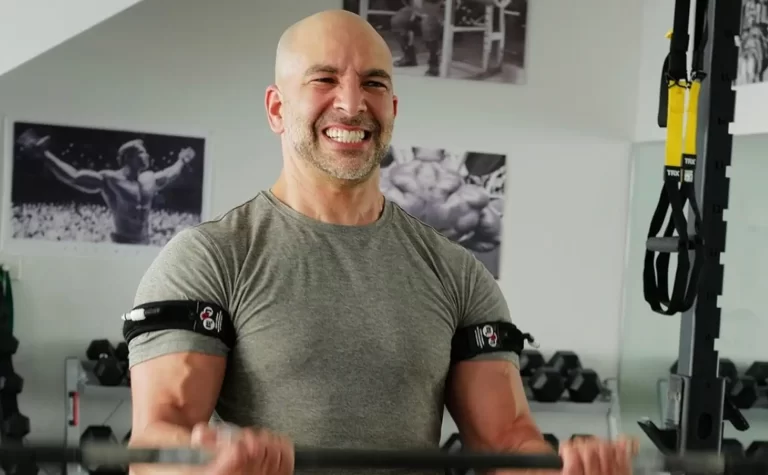
Inside Peter Attia’s Daily Routine for Longevity and Healthspan

Dr. Peter Attia has become something of a legend in longevity circles. As the host of The Peter Attia Drive podcast and author of the bestseller Outlive, he’s built a following of people hungry for science-backed strategies to extend not just lifespan, but healthspan.

What makes Attia compelling isn’t just his medical credentials or his ability to dissect complex research. It’s that he actually walks the walk. His daily routine reads like a masterclass in optimization, yet somehow maintains a human quality that makes it feel achievable rather than robotic.

From his pre-dawn wake-up to his remarkably early bedtime, every habit serves a purpose. In this deep dive, we’ll explore how this physician structures his days for maximum longevity, examining the morning rituals, afternoon workouts, and evening practices that form the backbone of his approach to living well.

Morning Routine

Peter Attia’s alarm rarely gets a chance to go off. Most days, he’s naturally awake between 4 and 5 a.m., a schedule that would horrify night owls but works perfectly for his biology. “It is not uncommon for me to wake up at 4 a.m. and go to bed at 8 p.m.,” he has said, treating those quiet predawn hours as sacred time.

But here’s where Attia surprises people. Instead of immediately diving into work during what he calls the “golden hours” of 4 to 7 a.m., he often chooses family over productivity. It’s a choice that reveals his priorities. For those interested in optimizing their own mornings, you might also find value in Andrew Huberman’s optimal morning routine, which shares some similar principles.

The very first thing he does upon waking? Hydrate. Not coffee, not checking his phone, but a glass of water mixed with electrolytes, often using something like Biosteel sports hydration mix. This simple act kickstarts his system after hours of dehydration during sleep. Only after proper hydration does the rest of his morning unfold.

The Meditation Practice

Attia’s approach to meditation is refreshingly practical. Using apps like 10% Happier or Sam Harris’s Waking Up, he spends about 20 minutes in practice. But his perspective on why he meditates is particularly insightful. “If I meditate for 20 minutes in a day, I’m not meditating for those 20 minutes… I’m meditating for the other 23 hours and 40 minutes,” he explains.

This isn’t about achieving some mystical state. For Attia, it’s mental training, pure and simple. The ripple effects of those morning minutes shape how he handles stress, maintains focus, and navigates decision-making throughout the entire day.

Supplements and Nutrition Strategy

While many people stumble to the coffee maker first thing, Attia has a different priority: his supplement stack. Every single morning, without fail, he takes AG1 (Athletic Greens). “Having a foundational program like AG1 makes it easier to go on autopilot and get the important, essential nutrients… I take a scoop of AG1 every day, regardless of what else I’m eating,” Attia notes.

His morning supplement routine goes well beyond a greens powder though. The lineup includes magnesium (specifically SlowMag), Carlson Super Omega-3 fish oil, vitamin D, baby aspirin, methylated B vitamins, and Pendulum’s Glucose Control probiotic. It might seem excessive to some, but Attia views it as insurance. Good nutrition is one of what he calls the “five pillars” of longevity, and he’s not leaving it to chance. For a complete breakdown of his supplement protocol, check out Dr. Peter Attia’s full supplement stack.

Coffee as Ritual

Only after hydration and supplements does caffeine enter the picture. Attia’s coffee routine borders on ceremonial. He crafts a French press with additions that would make baristas curious: a dash of chicory, a sprinkle of cinnamon, and a hint of vanilla. If you’re looking to upgrade your morning coffee ritual, this French press delivers consistently excellent results.

“Making a really good French press is something I like to do,” he says, often preparing a cup for his wife as well. The cinnamon isn’t just for flavor. Research suggests it can improve insulin sensitivity, turning his morning brew into yet another tool for metabolic health. This careful approach to coffee, coming after proper hydration and paired with breakfast rather than consumed on an empty stomach, shows his thoughtful approach to even simple pleasures.

Protein-Powered Breakfast

Forget intermittent fasting trends. Attia currently prioritizes protein above all else at breakfast, and his morning meal is substantial. Eight eggs is standard fare. Usually four whole eggs and four whites, served alongside buttered toast. If that sounds like a lot, that’s because it is. Attia aims for roughly one gram of protein per pound of body weight daily, and breakfast is where he starts stacking those numbers.

Sometimes he’ll add a protein shake to the mix, blending unsweetened almond milk with 50 grams of protein powder (he’s mentioned Promix as a favorite brand) and some berries. He’s observed that most people “are not getting sufficient amounts of protein to preserve lean mass,” a mistake that becomes increasingly costly as we age.

What makes his breakfast special isn’t just the macros though. It’s a family affair. Despite being someone who could easily maximize every minute for productivity, Attia deliberately keeps breakfast time sacred for his kids. Work can wait. Family can’t. After the children head to school, then and only then does his workday begin.

There’s something else worth noting about Attia’s mornings. He’s an archer and racing simulator enthusiast, and sometimes he’ll spend a few minutes with these hobbies before diving into professional work. “Archery will always keep you honest when it comes to focus and stillness,” he once observed. These aren’t time wasters but skill maintainers, activities that train concentration while bringing genuine enjoyment.

Deep Work Sessions

By mid-morning, Attia shifts into professional mode. A student of Cal Newport’s “Deep Work” philosophy, he blocks out time for cognitively demanding tasks when his mental energy peaks. This might mean writing for his blog, preparing for a podcast interview, or seeing patients in his longevity practice.

He approaches these work blocks with surgical precision, minimizing distractions and focusing completely on the task at hand. Years of medical training taught him to concentrate under pressure, and he applies that same intensity to his current work. By lunchtime, he’s often accomplished what others might consider a full day’s worth of high-priority tasks.

Afternoon Routine

The afternoon marks a dramatic shift in Attia’s day. This is when physical training takes center stage.

The Centenarian Decathlon Philosophy

Attia works out seven days a week, a schedule that might sound obsessive until you understand his framework. He’s not training for a beach body or a powerlifting meet. He’s training to be what he calls a “kick-ass 100-year-old.”

The concept is brilliantly simple. Attia encourages everyone to list ten physical tasks they want to be able to do in their final decades. His own list includes practical things like hiking a hilly trail, getting up from the floor using just one arm, hoisting luggage into an overhead bin, and carrying grocery bags up stairs. He calls this the “Centenarian Decathlon,” and every workout is designed to preserve these capabilities.

His training splits into four essential categories: stability, strength, aerobic efficiency, and anaerobic performance. Here’s what a typical week looks like in Attia’s gym:

Monday brings lower body strength training after his mandatory 10-minute stability warm-up. Tuesday shifts to Zone 2 cardio, that sweet spot of moderate intensity where you can still hold a conversation. Wednesday targets upper body strength. Thursday returns to Zone 2. Friday hits lower body again. Saturday combines Zone 2 with a brutal 30-minute Zone 5 interval session. Sunday somehow fits in both more Zone 2 and upper body work. For those interested in the science behind his approach, explore Peter Attia’s cardiovascular fitness protocol in detail.

The stability work deserves special mention. Every single day, before any other exercise, Attia spends ten minutes on what might look like simple movements. Core activation, balance drills, and something called DNS (dynamic neuromuscular stabilization). He describes it as “retraining movement patterns we learned as little kids.” It’s not sexy, but it’s the foundation that keeps him injury-free despite the intense volume.

Attia has called exercise “by far the most potent longevity drug,” and he means it. No pill, supplement, or medical intervention comes close to exercise’s impact on delaying death and preventing decline. In Outlive, he writes, “This isn’t an eight-week programโ€”it’s a lifelong pursuit.”

Rucking and Real-World Training

While gym work forms his foundation, Attia’s favorite “hidden gem” exercise is rucking. He’ll throw a 60-pound weight in a backpack and hike hills. He told Oprah Winfrey in an interview that this simple activity brilliantly combines cardio with strength training while mimicking real-life demands.

Sometimes he’ll wear a weighted vest for walks or set a treadmill to a steep incline with his ruck. Every exercise connects to his Centenarian Decathlon. He’s not doing arbitrary movements. He’s practicing for the physical demands of living.

After exercise, Attia makes a point of cooling down and recovery. He might spend a few minutes with a foam roller or doing active stretching to aid muscle recovery. While not daily, he also utilizes gadgets or techniques for recovery when needed โ€“ for instance, he monitors his heart rate variability and recovery through devices like the Oura Ring, and if he has access, he might do occasional cold therapy or sauna sessions (Attia has discussed that while not a daily habit for him, he acknowledges emerging research on their benefits). However, the cornerstone of his recovery strategy is actually quite simple: adequate nutrition and sleep, which he guards zealously.

Strategic Lunch

Lunch stays relatively light, especially post-workout. A massive salad topped with grilled chicken is typical. Mixed greens, cherry tomatoes, cucumber, olive oil and balsamic, plus a serious portion of protein. Some days he’ll have his famous “Peter Kaufman shake” instead, a caloric bomb of almond milk, heavy cream, Promix protein powder, almond butter, specialized carb powder, and berries.

Attia tracks his intake meticulously using apps like Carbon, aiming for about 2,700-2,800 calories daily with 45-50 grams of protein per meal across four meals. He focuses on what he calls nutritional biochemistry: adequate protein, quality fats, abundant micronutrients from vegetables. No rigid diet ideology, just sound principles.

He asks three key questions about diet: “Are you undernourished or overnourished? Are you undermuscled or adequately muscled? Are you metabolically healthy or not?” His own answers guide every food choice.

His views on fasting have evolved significantly. Once an enthusiast of extended fasts, even week-long quarterly fasts, he’s pulled back. “Most people do not consume enough proteinโ€ฆ the RDA is not sufficient as we age,” he warns. While he might still do occasional 16:8 intermittent fasting, maintaining muscle mass takes priority over any fasting protocol.

Afternoon Productivity

Post-lunch often means returning to work. Maybe recording a marathon podcast episode for The Drive, researching for newsletters, or consulting on complex longevity cases. Attia structures these sessions carefully, never scheduling mentally demanding tasks back-to-back. A writing block, then a walk. A podcast recording, then lighter administrative work. This rhythm maintains energy through the afternoon while ensuring he wraps up work in time for his evening routine.

Evening Routine

If mornings are about activation, evenings are engineered for deceleration.

Early Family Dinner

Dinner happens early in the Attia household, usually between 5 and 6 p.m. This timing isn’t random. With an 8:30 p.m. bedtime target, he wants digestion complete well before sleep.

A typical dinner might feature grilled salmon over a huge salad (he’s mentioned literally eating “a huge salad with one pound of salmon”), or a six-egg omelet loaded with vegetables when breakfast wasn’t egg-heavy. Sometimes it’s a curry stir-fry with tofu and vegetables, or a simple steak with salad. The constants remain: high protein, abundant vegetables, minimal refined carbohydrates.

He’ll occasionally indulge in sushi, savoring seaweed salad and sashimi with maybe a couple rolls. If hunger strikes later, a handful of macadamia nuts or an apple with almond butter might appear. But generally, dinner marks the end of eating for the day.

The Alcohol Equation

Attia’s relationship with alcohol is fascinating. “I love tequila. I love mezcal. I love really good wine, and I love really dark Belgian beer,” he admits. Yet most nights, he doesn’t drink at all.

When he does indulge, it’s strategic. One drink maximum, two on very rare occasions, and never close to bedtime. He tracks alcohol’s impact using his Oura Ring, noting how even moderate drinking raises his heart rate and disrupts heart rate variability during sleep. His rule? No more than seven drinks per week, often far fewer.

“Alcohol serves no nutritional or health purpose but is a purely hedonistic pleasure that needs to be managed,” he states. “If you’re going to drink, make it really fricking worthwhileโ€ฆ be mindful about it. You’ll enjoy it more and suffer fewer consequences.”

Evening Learning

After dinner comes family time. Games with the kids, homework help, bedtime stories. By 8 p.m., the household starts winding down.

Attia is a voracious reader, typically juggling two books simultaneously. One might be historical nonfiction like Bill Browder’s Red Notice, the other something philosophical like Don Miguel Ruiz’s The Four Agreements. “I’m wired in such a way that I can’t help but try to know more each day,” he says. This isn’t just entertainment. It’s continued education, a way to “sharpen the saw” as he puts it.

He reads for 30 minutes to an hour, using physical books or a Kindle rather than bright screens. This reading time serves as a bridge between the day’s intensity and the calm needed for sleep. He also wears blue-light blocking glasses in the hour or two before bed to filter out stimulating light.

Sleep: The Non-Negotiable

If exercise is Attia’s most potent longevity drug, sleep is the foundation everything else builds upon. He targets eight hours nightly and has engineered his environment to achieve it.

By 8:30 p.m., he’s in bed or nearly there. The bedroom becomes a cave. An OOLER cooling mattress pad keeps the bed temperature optimal. Blue-light blocking glasses filter evening light exposure. The Alaska Bear silk sleep mask ensures complete darkness. “Incredible darkness in the actual room at nightโ€ฆ I use this thing called the Alaska Bear shade,” he notes, because even tiny amounts of light can impair melatonin production.

His sleep supplement protocol varies based on need. Magnesium L-threonate (specifically Magtein brand) is the nightly constant, helping relax muscles and nerves. If he feels wired, he might add glycine (2 grams of Thorne brand) or ashwagandha (600 mg). Occasionally, low-dose melatonin (2-5 mg) or phosphatidylserine (600 mg) join the mix. “I keep a few sleep aids by my bed to use when needed,” he says, emphasizing that phosphatidylserine particularly helps when stress elevates nighttime cortisol.

Furthermore, Attia practices what sleep scientists call good sleep hygiene: his late evenings are kept calm and free of intense work or bright screens. He might do some light stretching or breathing exercises to relax. He keeps a Hydro Flask of water by the bed for hydration if needed, but generally avoids large amounts of fluid right before bed to minimize nighttime awakenings. All notifications on devices are off; in fact, Attia often leaves his phone outside the bedroom or on Do Not Disturb to avoid any disruptions. He also uses a sleep tracker (the Oura Ring) to monitor his sleep quality and quantity. By tracking metrics like sleep stages, heart rate, and movement, he can adjust his routine if needed (for instance, if he notices his deep sleep is lacking, he might examine evening caffeine or stress levels). Over time, he’s dialed in a system that works: he typically achieves near 8 hours of sleep from roughly 8:30 p.m. to 4:30 a.m., allowing him to wake up naturally before his alarm on most days feeling refreshed.

Finally, Attia even has protocols for special circumstances like travel. To combat jet lag, he will begin shifting his schedule to the destination time zone as soon as he boards a flight, use fasting strategically on travel days, and may utilize supplements like melatonin or even prescription wakefulness agents (in small doses) if absolutely needed to adjust sleep cycles. But on a normal night at home, the combination of a consistent early bedtime, a cool dark environment, and targeted supplements leads to high-quality sleep โ€“ which is the foundation upon which he can build those intense days again and again. As Attia often emphasizes, good sleep is non-negotiable. It affects everything from insulin sensitivity to cognitive function to exercise recovery. Chronic sleep deprivation accelerates aging at every level. By treating sleep as sacred, Attia ensures he can maintain his intense routine day after day, year after year.

Conclusion

Peter Attia’s daily routine reveals something profound about the pursuit of longevity. It’s not about perfection or deprivation. It’s about intentionality.

Yes, his 4 a.m. wake-ups and seven-day workout schedule might seem extreme. But notice the balance. Family breakfast matters as much as fasting protocols. A good book ranks alongside supplements. The occasional tequila has its place, carefully managed but genuinely enjoyed.

What can we mere mortals take from Attia’s approach?

First, protein and nutrition matter more than most realize. The RDA isn’t enough as we age. Supplements fill gaps, but whole foods come first. Track what you eat, at least initially, to understand where you stand.

Second, exercise isn’t optional. It’s medicine. More powerful than any drug for extending healthspan. Build stability, strength, and endurance. Train for the physical tasks you want to perform at 100, not the body you want at 30.

Third, mornings set the tone. Whether it’s 4 a.m. or 7 a.m., how you start matters. Hydrate first. Move with intention. Protect time for what’s important, whether that’s meditation, family, or focused work.

Fourth, evening routines directly impact tomorrow’s performance. Early dinners, minimal alcohol, blue light management, cool dark bedrooms. These aren’t biohacker gimmicks. They’re evidence-based practices that compound over time.

Finally, stay curious and keep adapting. Attia’s routine today differs from five years ago. As science evolves and his body changes, so does his approach. Rigidity kills progress. Experimentation drives optimization.

Peter Attia shows us that longevity isn’t about living forever. It’s about maintaining vitality, capability, and joy for as long as possible. His routine might seem regimented, but it’s actually a framework for freedom. Freedom from disease, disability, and decline. Freedom to play with grandchildren, pursue passions, and contribute meaningfully well into our later decades. For a complete guide to his philosophy and methods, Outlive offers the full blueprint.

We don’t need to copy Attia’s routine wholesale. But we can adopt his mindset: every choice either builds or erodes our future capacity. By making more choices that build, we stack the odds in favor of not just a longer life, but a better one.

As Attia might say, it’s not about the years in your life, but the life in your years. His daily routine is simply his method for maximizing both. For those interested in comparing approaches, you might also explore Dr. David Sinclair’s supplement list for longevity to see how different experts tackle similar goals.


References

Peter Attia’s Daily Routine in 2025

Peter Attia’s workout routine: A science-backed approach to longevity and health | Nucleus

Peter Attia’s Workout Routine: How to Workout to Live Longer

Peter Attia’s Daily Routine & Outlive Book Summary ยท Colin Keeley

Am I fooling myself? – Peter Attia

Exercising for Longevity | Peter Attia, M.D.