
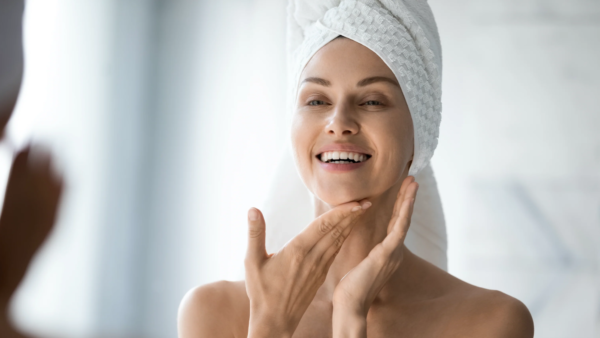
Somewhere around month three on my GLP-1, a coworker asked if I’d been sick. Not “wow, you look great,” just a concerned “hey, are you feeling okay?” I’d lost 28 pounds and felt amazing. My face apparently had other plans.
If you’ve noticed your cheeks look hollower, your under-eyes look darker, or your skin has this slightly deflated quality that wasn’t there before, you’re not imagining it and you’re definitely not alone. There’s a name for it now: Ozempic face. And whether you’re on Ozempic, Wegovy, Mounjaro, or Zepbound, the mechanism behind it is the same.
Here’s what’s really happening to your skin, what the research says works to protect it, and what’s mostly marketing noise.
What “Ozempic Face” Really Means
The term showed up so fast that dermatologists and plastic surgeons were writing about it before most people had even heard it. A 2024 review in Dermatological Reviews laid it out clearly. Rapid, significant weight loss from GLP-1 medications causes a loss of facial subcutaneous fat, and that loss shows up as hollowed cheeks, more prominent nasolabial folds, sagging around the jaw, and skin that looks older than it did before treatment started.
What’s useful about that framing is it takes the mystery out of it. Your skin isn’t failing you and it isn’t aging overnight. A predictable, mechanical result of fat loss is simply playing out somewhere everyone can see, including strangers in the grocery store who have opinions about your face they didn’t ask to have.
A more recent paper, published in 2026 and tracking the clinical response to this exact issue, frames it as an “unintended consequence” of fast fat loss rather than anything specific to the drugs themselves. Your face has fat pads, called buccal fat, that give cheeks their fullness and youthful shape. When you lose weight quickly, those pads shrink along with everything else.
The problem is your face doesn’t have much room to lose fat gracefully. Thin layers of skin sit directly over fat and bone, so even a modest reduction is visible fast. Compare that to your stomach or thighs, where there’s more fat volume to lose before the skin on top notices much of anything.
Interest in fixing it has climbed right alongside interest in the medications. A Google Trends analysis published this year found searches for facial volume restorative procedures, things like fillers and fat transfer, rising in direct correlation with GLP-1 prescription trends. Plastic surgeons aren’t speculating about this being a real phenomenon anymore. They’re booking appointments for it.
Why Speed Matters More Than the Number on the Scale
This is the part that gets lost in the conversation. It’s not really the amount of weight you lose that wrecks your skin. It’s how fast you lose it. Skin has a certain amount of elasticity, meaning its ability to stretch and then bounce back. That elasticity comes from collagen and elastin fibers in the dermis, and both naturally decline with age starting in your late twenties.
Give your skin time to adjust gradually, and it has a fighting chance to remodel along with your shrinking frame. Drop weight at the pace GLP-1s can produce, sometimes 1 to 2 percent of body weight per week in the early months, and the skin simply can’t keep up. It’s the same reason a balloon that’s been inflated for years doesn’t snap back the way a brand new one does.
Age plays into this too. Someone in their twenties losing 50 pounds fast still has collagen-rich, elastic skin doing a lot of the work for them. Someone in their fifties going through the same transformation is working with skin that already has less rebound capacity. Neither group is destined for loose skin, but the odds shift.
Genetics factor in too, more than most people want to hear. Some families just have more elastic skin than others, the same way some people tan easily and others burn. You can’t control your genetics or your age, but you can control the two things within reach, which are how fast you’re losing weight and whether your skin has the raw materials it needs to keep up.
It’s Not Just Your Face
Everyone fixates on the face because it’s the part you see in every mirror, every selfie, every Zoom call. But the same collagen and elastin story is playing out under your arms, around your midsection, and along your inner thighs. Your face just shows it first because the skin there is thinner and the fat layer underneath is smaller to begin with.
Treating “Ozempic face” as a totally separate problem from body skin laxity misses the point. Whatever supports collagen production and skin structure for your face is doing the same job everywhere else. That’s useful, because it means you don’t need ten different protocols. You need one that works on the mechanism.
What the Research Supports
I’ll be upfront that there’s no single pill or cream that undoes rapid fat loss overnight. Anyone promising that is selling you something. But a handful of approaches have real evidence behind them, and they stack well together.
Slow Down Where You Can
You can’t fully control your response to the medication, but you have more say over pace than it feels like. Working with your prescriber on a slower titration schedule, giving your body longer at each dose before stepping up, tends to produce steadier weekly loss instead of dramatic early drops.
A loss of around 1 to 2 pounds a week is generally considered gentler on skin than faster rates, even though GLP-1s often push past that in month one or two. If your weekly drops look more like 4 or 5 pounds for several weeks straight, that’s worth a conversation at your next appointment, not just something to ride out.
Prioritize Protein, Seriously
Collagen is a protein. Your body needs amino acid building blocks, particularly glycine, proline, and lysine, to keep producing it. When appetite suppression leaves you eating 900 calories a day of whatever sounds tolerable, protein intake usually craters first because it takes more effort to prepare and eat than carbs do.
Aiming for 25 to 30 grams of protein per meal, even in small portions, gives your body the raw material it needs for skin repair alongside muscle retention. These two things are more connected than people realize. Preserving lean muscle mass underneath the skin also helps maintain some structural support that fat loss alone strips away.
Don’t Skip Hydration
Skin cells are mostly water, and dehydrated skin looks thinner, duller, and less plump no matter what’s happening underneath. GLP-1s reduce thirst cues the same way they reduce hunger cues, so a lot of people quietly under-drink for months without noticing. Keeping water intake consistent, not just when you remember, gives your skin a baseline of resilience it needs to look its best while your face shape is shifting.
Collagen Supplementation
The evidence on oral collagen peptides is mixed but not nothing. Several small human trials have found that hydrolyzed collagen supplementation improves skin elasticity and hydration measurably over 8 to 12 weeks, though effect sizes vary and not every study agrees. It’s not a dramatic fix, but it’s a low-risk one, and getting that extra collagen-building material in during a period when your diet is already restricted isn’t a bad idea.
A plain hydrolyzed collagen peptide powder that mixes into coffee or a smoothie is the simplest way to add this without extra effort. Vital Proteins Collagen Peptides dissolves without clumping and doesn’t change the taste of much.
GHK-Cu: The Copper Peptide Everyone’s Asking About
This is the one with real research behind it, not just marketing copy. GHK-Cu is a naturally occurring copper peptide that declines in your body with age, and it’s been studied for decades for its role in wound healing and tissue remodeling.
A detailed review of the gene expression data found that GHK-Cu modulates over 4,000 human genes, many of them tied directly to collagen and elastin synthesis. Lab work has shown it increasing collagen production while also regulating the enzymes, known as MMPs, that break collagen down as skin ages or stretches.
Topically applied, it’s one of the better-researched peptides in skincare, which is a low bar in an industry full of unproven ingredients, but GHK-Cu clears it. It won’t rebuild lost facial fat pads. Nothing topical will. What it can do is support the collagen and elastin that keep your existing skin structure tighter and more resilient while your face finishes adjusting to its new shape.
I’ve been using the Infiniwell GHK-Cu serum at night for the last couple months and it’s become a real part of my routine, not just something I remembered to use for a week. Code WELCOME15 knocks 15 percent off if you’re a first-time customer there.
What’s Worth It vs What’s Hype
The Skincare Basics Nobody Mentions
While everyone’s talking about peptides and collagen, the boring fundamentals get skipped, and they matter more than people assume. Sun exposure breaks down collagen and elastin through a completely separate pathway from weight loss, and it adds up on top of whatever your face is already dealing with. A daily SPF 30 or higher isn’t optional here, it’s foundational.
Retinoids are the other piece with decades of solid research behind them for stimulating collagen production and improving skin texture. A low-strength over-the-counter retinol a few nights a week is a reasonable starting point if you’ve never used one, building up tolerance before going stronger.
Combine consistent SPF and a retinoid with the nutrition and hydration pieces above, and you’ve covered the parts of this with real evidence behind them, not just hype.
How Long Does This Take to Settle?
This is the question I get asked most, and the honest answer is it depends on how much weight you’ve lost and how fast. Most people notice the hollowing accelerate during the steepest part of their weight loss, usually the first three to six months on a GLP-1, and then see it level off once their weight stabilizes.
Once you hit maintenance dosing and your weight holds steady for a few months, your body tends to redistribute a small amount of fat back into your face as things normalize. It’s not dramatic, and it won’t undo everything, but it’s a real pattern plenty of people notice around the six to twelve month mark. Patience matters here more than any single product does.
When a Serum Isn’t Enough
Sometimes the volume loss is significant enough that no topical routine is going to close the gap, and that’s a completely normal outcome of losing a large amount of weight. Dermatologists and plastic surgeons are now treating this specific scenario regularly.
Hyaluronic acid fillers can restore cheek volume directly. Radiofrequency treatments, including a newer bipolar RF approach documented in a 2026 case series, are being used specifically to tighten skin laxity tied to GLP-1 weight loss, with providers reporting meaningful improvement in facial contour within a handful of sessions.
None of this is required. Plenty of people lose significant weight on these medications and are perfectly happy with how their face settles once they reach maintenance. But if it’s bothering you enough to think about it daily, a consultation with a board-certified dermatologist costs you nothing but time and gives you real options instead of guessing from TikTok comments.
Mistakes That Make It Worse
- Cutting calories far below what your prescriber recommends to speed things along. Faster loss means less time for skin to adapt.
- Skipping protein because meat and eggs feel unappealing on a suppressed appetite. Protein shakes and cottage cheese exist for exactly this problem.
- Ignoring strength training because cardio feels like the obvious weight loss tool. Muscle underneath the skin provides real structural support.
- Assuming sunscreen doesn’t matter because you’re focused on weight. UV damage breaks down collagen independently of anything happening with your medication.
- Waiting a year to address it because you assume nothing can help. Early, consistent habits do more than a rushed fix at the end.
FAQ
Does Ozempic face go away?
Often, yes, at least partially. Once weight stabilizes, some facial fullness tends to return as your body settles into maintenance. It usually won’t fully return to your pre-weight-loss appearance, but the hollowed, gaunt look tends to soften over several months.
Does this happen on every GLP-1 medication?
Yes. Semaglutide (Ozempic, Wegovy) and tirzepatide (Mounjaro, Zepbound) both cause rapid fat loss through the same appetite-suppression mechanism, so facial volume loss shows up across all four brand names, not just the one that got the nickname.
Can collagen supplements fix loose facial skin?
They can modestly support skin elasticity over time, but they won’t restore fat volume you’ve lost. Think of collagen support as one piece of a bigger approach, not a standalone solution.
Is GHK-Cu safe to use long term?
Topical GHK-Cu has a long track record in skincare formulations and is generally well tolerated. As with any new topical, patch testing first and checking with a dermatologist if you have sensitive skin or existing conditions is a reasonable precaution.
Where can I buy a GHK-Cu serum?
The Infiniwell GHK-Cu serum is the one referenced throughout this article. First-time customers can use code WELCOME15 for 15 percent off.
Will losing weight slower prevent this?
It lowers your odds and often reduces severity, but it’s not a guarantee. Genetics, age, and how much weight you’re losing overall all play a role too.
The Takeaway
Losing weight and watching your face change at the same time is a strange trade-off nobody fully prepares you for. The good news is you’re not stuck choosing between the two. Pacing your weight loss where you can, eating enough protein, staying hydrated, and supporting your skin’s own collagen production with something like topical GHK-Cu gives you a real shot at keeping your skin resilient while your body does the harder work underneath.
And if your face settles in a way you’re not thrilled with months from now, that’s a conversation for a dermatologist, not a reason to stop a medication that’s working for you everywhere else.
This article is for educational purposes only and is not medical advice. Talk to your prescriber or a dermatologist before starting any new supplement or skincare routine, especially while on a GLP-1 medication.
This article contains affiliate links. BrainFlow may earn a commission on qualifying purchases at no additional cost to the reader. We only recommend sources we trust.