
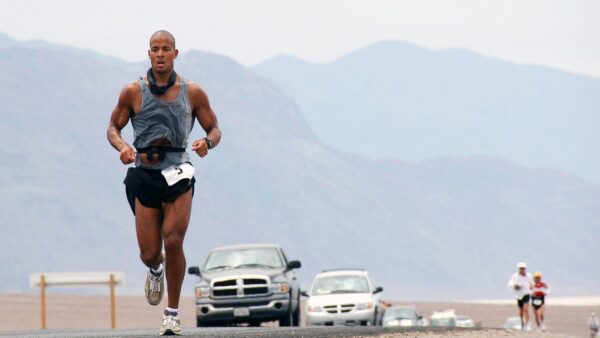
Most mornings, the hardest decision you make is whether to hit snooze once or twice. David Goggins built an entire identity out of never touching that button, and somewhere along the way his 3 a.m. alarm turned into a small industry of blog posts that all say roughly the same three things and call it a day.
What most of them leave out is that the miles are the least interesting part. Goggins has said outright that his routine isn’t about the run, it’s about winning an argument with the voice in his head before the sun comes up. That argument, and the mental framework behind it, is the part worth stealing. The run is just where he practices it.
This is what his mornings look like in 2026, what the research says about the pieces backed by more than vibes, what his body has survived to keep this going for two decades, and which parts are worth borrowing even if you have zero interest in running 12 miles before breakfast.
Quick Facts
Wake-up time
3 to 4 a.m.
Morning run
10 to 15 miles, fasted
Stretching
2 to 3 hours daily
Sleep
6 to 7 hours typical
Diet pattern
16:8 fasting, high protein
Bedtime
9 to 10 p.m.
Who David Goggins Is, and Why the Story Matters Here
Born in Buffalo, New York in 1975, Goggins spent his early childhood in a household his own books describe as physically and psychologically abusive. He struggled with a stutter, an undiagnosed learning disability, and asthma, and graduated high school with a 1.6 GPA. None of that is trivia. It’s the reason his morning routine reads less like a fitness plan and more like a system for a person who spent years distrusting his own mind.
By his early twenties he was working as an exterminator, well over 300 pounds, and going nowhere. Seeing a television segment about Navy SEAL training became the trigger. He had roughly three months to lose over 100 pounds to even qualify for a shot at BUD/S, and he did it. He was later diagnosed with sickle cell trait during training, a condition that increases the risk of sudden death under extreme exertion, and it didn’t stop him.
He’s the only member of the U.S. Armed Forces on record to complete SEAL training, Army Ranger School, and Air Force Tactical Air Controller training. He set the Guinness World Record for pull-ups, 4,030 of them in 17 hours, and has finished more than 60 ultramarathons, ultra-distance triathlons, and endurance events, including running 205 miles without sleep during a 2007 event for the Special Operations Warrior Foundation. More recently, he’s rebuilt a second career around emergency medicine and wildland firefighting, detailed further down. That’s the pattern his entire adult life has followed: find the thing you’re worst at, then live inside it until you’re not.
The Morning, Hour by Hour
The full arc at a glance, then the detail on each piece below.
3 to 4 a.m.: The Alarm Doesn’t Get a Vote
Goggins wakes between 3 and 4 a.m. most days, no snooze, no negotiation. He’s described the seconds right after the alarm as the actual test, not the run that follows it. There’s a voice that shows up immediately arguing for five more minutes, and he calls that voice the governor. The entire point of the early wake-up isn’t the extra hours in the day, it’s refusing to listen to that voice even once, because he believes every time you give in, the governor gets a little stronger and a little louder tomorrow.
There’s real research behind an early wake-up, though it’s more specific than most articles present it. A 2021 genetic study in JAMA Psychiatry tracking over 800,000 people found that shifting your sleep midpoint one hour earlier, while keeping total sleep the same, was associated with a 23% lower risk of major depression. That’s an important detail Goggins’ own habits don’t always follow. He’s openly said he sometimes runs on three hours of sleep during heavy training blocks, which isn’t the same variable the study measured at all. The research supports waking up earlier on the same amount of sleep, not chronic sleep deprivation, and that distinction matters if you’re borrowing from this routine instead of just admiring it.
3:15 a.m.: A Fasted Run, Because He Hates It Most
He laces up and heads out the door on an empty stomach, usually somewhere between 10 and 15 miles, and he’s referred to 12 miles as close to a hard floor for the morning run. In an interview with Chris Williamson, he explained the logic in a phrase that’s since been repeated everywhere.
“I armor-plate my mind and body first. That run is like putting on body armor.”
David Goggins
The world gets a vote the second he opens the door, checks his phone, or talks to anyone else. The run is how he gets ahead of that.
He’s picked running specifically because it’s the activity he dislikes most, not despite that fact but because of it. His own reasoning is blunt: that’s the one thing he hates doing more than anything else, so it’s the first thing he does, treating it the way most people treat their morning coffee. Weather doesn’t factor into the decision. Rain, heat, freezing cold, the run happens. That consistency, not the mileage itself, is the actual habit he’s built, and it’s the piece that’s hardest to fake.
During peak training blocks for an ultramarathon or a record attempt, this expands into a second run around midday and a cycling session in the afternoon, sometimes 70 to over 100 miles of combined movement across a single week. That volume isn’t the daily baseline. It’s what happens when the baseline gets stacked on top of itself for months at a time, which is worth knowing before anyone assumes this is a sustainable year-round number.
5:15 to 6:30 a.m.: A Small Meal, Then the Gym
After the run, Goggins eats something light rather than a full meal. Accounts vary depending on the interview and the year. Sometimes it’s black coffee blended with grass-fed butter and MCT oil, a high-calorie combination often called Bulletproof coffee. Other times he’s described a simpler plate of oatmeal with fruit and a protein source. What’s consistent across every account is the pattern underneath it: he runs fasted, then breaks that fast with something small and protein-forward rather than a heavy breakfast, and he’s talked about following roughly a 16:8 intermittent fasting window on days built around a hard morning session, closing his eating window by early evening.
From there he heads into 45 minutes to 90 minutes of strength work, mostly calisthenics like pull-ups and push-ups rather than a traditional weight room split. Nothing complicated. High volume, done consistently, is the whole strategy, and it’s the same approach that got him the pull-up world record in the first place: he trained for that attempt by doing tens of thousands of pull-ups over roughly nine months, not by chasing a single flashy program.
Pull-ups specifically get treated as a daily benchmark rather than a single workout item, spread across the day in sets rather than done all at once, sometimes on a doorway bar he can hit between other tasks. His own explanation strips away any interest in aesthetics.
“I don’t do pull-ups to get big arms. I do pull-ups because it’s a simple test. Can I pull myself up? Every day, can I do that?”
David Goggins
One version of this that’s circulated as a starting protocol is doing 10 sets across the day, wherever your current max happens to be, and building from there rather than trying to hit a number all at once.
Midday: Work, a Second Session, Pull-Ups Between Tasks
The gym session doesn’t close out his physical output for the day. During peak training blocks he fits in a second run or a cycling session around midday, and even outside of peak training, movement doesn’t stop just because he’s at a desk. Pull-up sets, walks, and calisthenics fill the gaps between meetings, writing, and prep for speaking engagements. Supplementation is minimal and unremarkable by comparison to the rest of the routine: he’s mentioned creatine and protein powder as part of his regular stack, nothing exotic.
Gear and Recovery: Minimal by Design
His equipment list is short on purpose: running shoes, a doorway pull-up bar you can pick up on Amazon for under $30, and a bike. During peak training blocks he skips the gym entirely, favoring movements that demand mental commitment over machines that remove friction from the effort. That’s a deliberate choice, not a budget constraint.
Recovery follows the same logic. He uses cold showers rather than a cold plunge tub, taken after training with no ceremony around it.
“I don’t need a $5,000 cold plunge. Cold water is cold water. The point isn’t the gear. The point is choosing discomfort.”
David Goggins
That line cuts against most of the current wellness-gadget market, and it’s consistent with everything else about how he trains. The cold shower isn’t there for inflammation markers. It’s another rep at overriding the part of his brain that wants the easier option.
Stretching: The Two Hours Nobody Talks About Enough
Somewhere in his day, usually split between morning and evening, Goggins puts in two to three hours of stretching. He’s described his body as having locked up almost entirely at one point from years of overtraining without recovery, and the stretching routine is the fix he’s stuck with ever since, missing it only a couple of days in the last several years by his own account.
This is the one piece of his routine with real clinical backing behind it. A study in the Journal of Physical Therapy Science found that a consistent stretching program performed comparably to manual therapy and strengthening exercises for chronic neck pain over a 12-month period. You don’t need two hours to get a version of that benefit. Goggins runs an extreme dose because his training volume and his joint history demand it. Fifteen to twenty minutes gets most people most of the way there.
Evening: Reflection Before the Cycle Repeats
Goggins goes to bed relatively early, usually somewhere between 9 and 10 p.m. when his schedule allows it, giving him roughly six to seven hours of sleep against a 3 or 4 a.m. wake-up. He’s said he prefers seven to eight hours when he can get it, but treats sleep as something to work around rather than a hard boundary. Before bed, he runs a private version of an after-action review, asking himself whether he gave full effort that day and what he avoided, then carries whatever the answer is into the next morning’s mirror session.
The evening stretching block doubles as something closer to meditation than most people realize. He’s described it directly.
“You have to spend a hell of a lot of time with yourself, learning about yourself. So every night, that’s what I do when I’m stretching and meditating.”
David Goggins
It’s not a separate practice bolted onto the schedule. The confrontation with negative self-talk happens inside the same two hours his joints are recovering, which is part of why the stretching block runs as long as it does.
The Mental Framework Is the Actual Product
Miles and pull-up counts are easy to copy and paste into a listicle. The mental tools Goggins built his entire philosophy around get mentioned far less often, and they’re the pieces that transfer to a life that doesn’t involve ultramarathons.
The Accountability Mirror
Every morning, he stands in front of his bathroom mirror and confronts a specific gap between who he currently is and who he wants to become, sometimes with sticky notes covering the glass listing goals, failures, and insecurities in plain language. It’s uncomfortable by design. The discomfort is the point. He’s described most people as avoiding this exact exercise because brutal honesty about your own shortcomings is one of the few things harder than a 12-mile run.
The 40% Rule
From his book Can’t Hurt Me, the idea that when your mind tells you you’re completely done, you’ve only used about 40% of your real capacity. He didn’t pull this from a lab. It’s a personal framework built from ultramarathon experience, useful as a mindset tool but worth treating as exactly that rather than a physiological fact you could verify in a study.
The Cookie Jar
This one gets skipped constantly, and it might be the most useful of the three. The concept traces back to his childhood, when his mother kept an actual cookie jar in the kitchen and rationed out a couple of cookies at a time as a small, earned reward. As an adult, Goggins built a mental version of it: a specific, written inventory of real moments he’s overcome, from passing a test he’d failed before to losing over 100 pounds to qualify for SEAL training. When a race or a workout gets unbearable, he mentally reaches into that jar and pulls out a memory of a past win to prove to himself, with evidence, that he’s capable of pushing through. It’s not generic self-talk. It’s a rehearsed, specific list, which is exactly why it works better than a vague pep talk.
What His Body Has Survived to Keep This Going
This is the part most routine breakdowns skip entirely, and it changes how you should read everything above it. Goggins has run this exact philosophy through a body that’s required multiple major surgeries, and pretending otherwise does a disservice to anyone trying to learn from him.
In 2009, doctors discovered he’d been training and competing his entire adult life with an atrial septal defect, a congenital hole in his heart that had gone undetected through years of military physicals. He’d run 205 miles at a Race Across America event the year before it was found, all while his heart was operating at a fraction of its intended efficiency. The hole was large enough that surgeons needed two procedures to fully repair it, and he was off active duty for roughly three years during the recovery.
Decades of running on pavement eventually caught up with his knees. He’s dealt with severe bone-on-bone arthritis and underwent a high tibial osteotomy, a surgery that involves cutting and repositioning the shin bone to shift weight away from the damaged part of the joint. Doctors told him afterward that he should stop running entirely. He didn’t. In 2021 he also had surgery to insert rods and screws after a serious leg injury.
The running itself has cost him more than the joints. He’s dealt with stress fractures and a documented case of rhabdomyolysis, a condition where overworked muscle tissue breaks down and leaks into the bloodstream, serious enough to cause kidney damage if it goes untreated. He’s run through both anyway, and he’s said as much without dressing it up.
“I run every day. Even when I’m broken. I’ve run on stress fractures. I’ve run with rhabdo. Running is my therapy. It’s my church.”
David Goggins
None of this is included to undercut the routine. It’s included because the honest version of this story is more interesting than the sanitized one, and because anyone building their own version of this discipline should understand that Goggins’ relationship with pain isn’t a metaphor. It’s the reason his own books spend as much time on injury and recovery as they do on mileage, and he’s been direct that he doesn’t hold his own injury history up as a model to copy.
What He’s Doing Now, Beyond the Routine
The mornings haven’t changed much, but the rest of his life has kept moving. In 2022 he released Never Finished, the follow-up to Can’t Hurt Me, which debuted at number one on Amazon and Audible and became a New York Times bestseller in its own right. Where the first book was the origin story, he’s described the second as the deeper material, built around later challenges rather than the SEAL training narrative that made him famous.
Off the page, he’s spent recent years training as an Advanced Emergency Medical Technician and working shifts in a big-city emergency room, alongside summers spent as a wildland firefighter and smokejumper in British Columbia. He became a rookie smokejumper at 47, an age where most people in that line of work are long retired from it, and he’s talked about the decision the same way he’s talked about everything else: pick the thing you have no business being good at, then go be bad at it in public until you’re not.
Common Myths About the Routine
A few claims circulate constantly and don’t hold up well under scrutiny.
What’s Worth Borrowing
Nobody needs to run 12 fasted miles before sunrise, or survive two heart surgeries, to take something useful from this. Goggins himself has said as much. The principle matters more than the mileage.
- Pick your own “run.” Identify the one task you consistently avoid and do it first, before your phone, before anyone else’s demands get a say.
- Shift your wake time, not your sleep total. The depression-risk research is about an earlier midpoint at the same duration, not less sleep. Move the whole schedule earlier instead of just cutting hours.
- Steal the mirror, not the mileage. A genuine, specific, written accounting of where you stand does more than a vague New Year’s resolution ever will.
- Build a real cookie jar. Write down five to ten specific things you’ve overcome, not just achievements but genuine obstacles. Keep the list somewhere you’ll see it when you need it.
- Build in real recovery. Even 15 minutes of consistent stretching most days beats zero, and the research backs that dose showing up over months, not once.
- Treat consistency as the actual skill. Goggins’ defining trait isn’t intensity, it’s showing up in the rain and the cold with no exceptions. That’s copyable at any fitness level.
- Respect your own body’s limits. Goggins pushed through injuries most people would have stopped for, and it cost him multiple surgeries. Discipline and ignoring your body are not the same thing, and his own story makes that distinction clearer than most of his imitators do.
David Goggins Morning Routine FAQ
What time does David Goggins wake up?
Between 3 and 4 a.m. most days, with no snooze button involved. He’s described the moment right after the alarm, not the workout itself, as the real test of the morning.
How far does David Goggins run every morning?
Typically 10 to 15 miles, fasted, regardless of weather. He’s referred to 12 miles as close to a hard minimum for his morning run, with additional cardio sessions layered in later in the day during heavier training blocks.
What does David Goggins eat for breakfast?
It varies by interview and training phase. Sometimes it’s Bulletproof coffee with MCT oil, other times oatmeal with fruit and a protein source. The constant is a fasted run first, followed by something light rather than a full meal, inside a roughly 16:8 intermittent fasting pattern on training days.
How much does David Goggins stretch?
Around two to three hours a day, split across morning and evening. He’s said he’s missed this only a couple of days in the last several years, and he’s linked the habit directly to recovering from a body that had locked up from years of overtraining.
Does David Goggins have any health issues from all this training?
Yes. He underwent two surgeries to repair a congenital heart defect discovered in 2009, has had knee surgery for arthritis after doctors told him to stop running, and had surgery to insert rods and screws following a leg injury in 2021. He’s been open about all of it in his books and interviews.
What is the David Goggins “cookie jar” method?
A mental technique from his book Can’t Hurt Me where he keeps a specific, written list of past moments he’s overcome and mentally revisits them during extreme physical or mental difficulty, using proof of past resilience to push through the current one.
What supplements does David Goggins take?
He’s kept it minimal in interviews, mentioning creatine and protein powder as part of a basic stack. Nothing about the routine leans on supplementation the way it leans on volume, consistency, and the mental frameworks.
Does David Goggins take rest days?
Not in the traditional sense. He’s spoken about favoring active recovery over complete inactivity, using lighter movement and his stretching routine instead of a full day off, even during lower-intensity stretches of training.
Does David Goggins still follow this routine in 2026?
Based on his recent interviews and public appearances, yes, with the same early wake-up, fasted running, and stretching commitment that’s defined his mornings for years. He’s continued to add new challenges on top of it, including working as an Advanced Emergency Medical Technician and spending summers as a wildland firefighter and smokejumper in British Columbia.
The Takeaway
Copying David Goggins’ exact schedule is a fast way to get hurt or quit within a week, and his own knees are proof that even he paid a real price for pushing this hard for this long. Copying his actual method, doing the one thing you hate first and being brutally specific about where you stand, works at any mileage.
Start smaller than you think you need to. Wake up 30 minutes earlier than usual. Pick one task you’ve been avoiding and do it before anything else gets your attention. Write down five things you’ve already overcome so you have somewhere to reach when it gets hard. The armor isn’t built in a single brutal morning. It’s built by showing up on the mornings you’d rather not.