BPC-157 dosage is one of those topics where everyone repeats the same numbers and almost nobody can tell you where they came from. 250 to 500 mcg a day. Twice daily near the injury. Four to eight weeks. Those numbers are fine, and this guide uses them, but it also shows the rat and dog studies behind them, works the reconstitution math by hand for 5mg, 10mg, and 20mg vials, and gives you a calculator so you never have to trust a chart mixed at someone else’s ratio.
It also covers the parts most dosage pages skip. How to inject, where, and how to rotate sites. How to store a mixed vial. What a realistic results timeline looks like. What changed legally in April and July of 2026. Updated September 2026.
Quick Answer
Most people take 250 to 500 mcg of BPC-157 a day, subcutaneous, split into one or two shots, for 4 to 8 weeks. Injecting close to an injury is common practice. A 10mg vial mixed with 2 mL of bacteriostatic water gives 5 mg/mL, so 250 mcg is 5 units on an insulin syringe and the vial holds 40 doses, about 20 days of twice-daily use. Full breakdown by goal, route, and vial size below, plus a calculator.
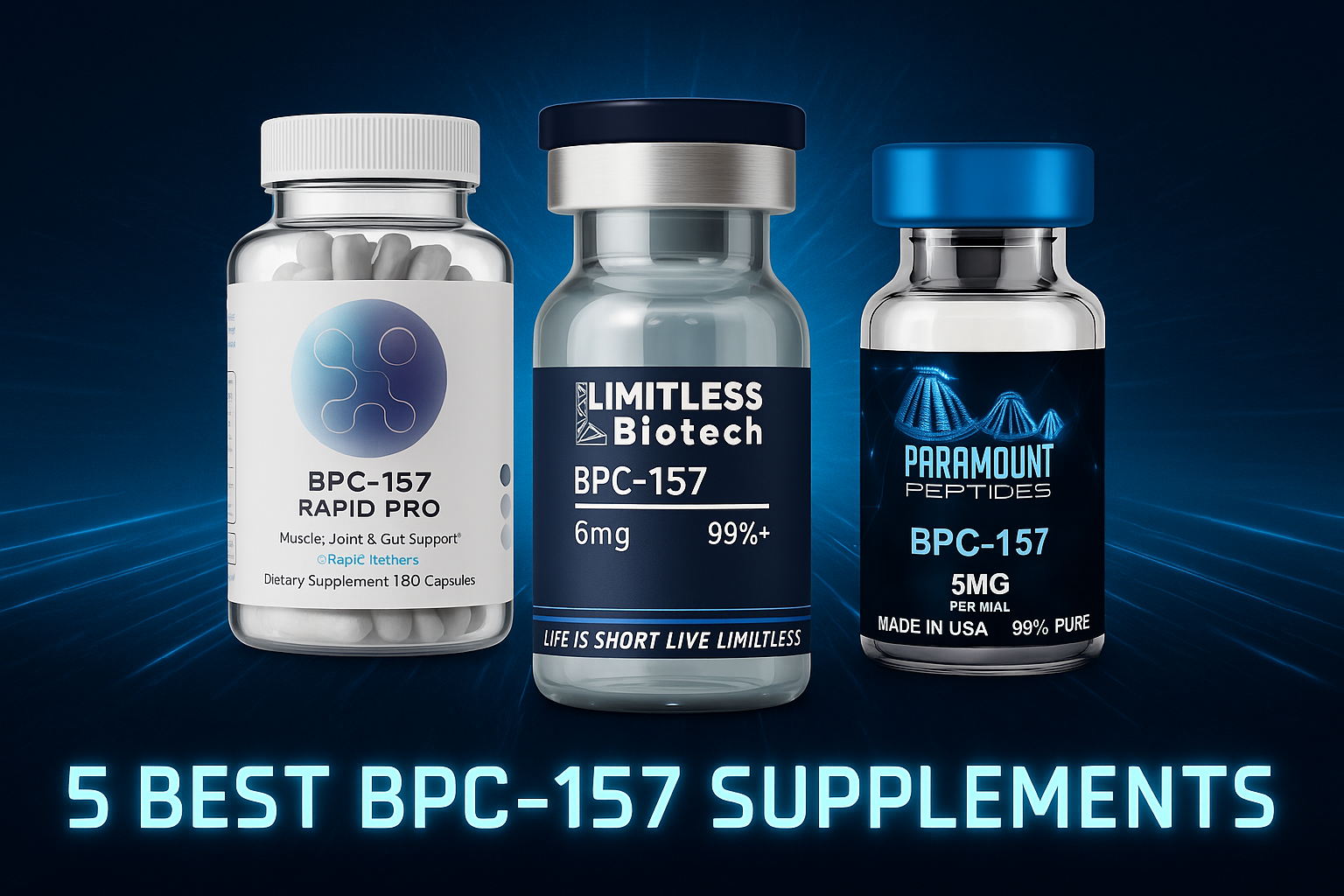
Our pick for sourcing it is Paramount Peptides, which synthesizes BPC-157 in-house in Irvine, California and posts a lot-specific COA from Accumark Labs on the product page. The 10mg vial is $63.75, the 20mg is $96.05, and code BRAINFLOW takes 10% off either. Every reconstitution example below is worked for their vial sizes.
Nearly half off everything at Everest Peptides
Everest Peptides' card processor is offline right now, so instead of waiting it out they're running a bank payment sale. Every peptide is 40% off, and code BRAINFLOW stacks another 15% at checkout. Pay with Zelle or Pay by Bank, same day shipping before 3pm ET, every batch third-party tested with the COA on the product page. Rated 4.9 on Trustpilot.
Shop the 40% off sale Code BRAINFLOW at checkout. Zelle and Pay by Bank only during the sale.BPC-157 Dosage Chart
The ranges below are what the BPC-157 community and vendor world have settled on. No human trial has established an official dose, which the research section near the end covers in detail. Treat these as convention, not prescription.
BPC-157 Dosage by Goal
Tendon, ligament, and joint injury
This is the use that made BPC-157 famous outside the gut literature, and it’s the one where people run the highest doses for the longest time. 250 to 500 mcg a day, usually split into two shots, for 6 to 12 weeks. Connective tissue heals slowly and has poor blood supply, which is the argument for the longer run.
Injecting near the injury shows up most often here. A rotator cuff gets a shot into the fat over the shoulder. A tennis elbow gets one on the forearm. Nobody has tested whether local injection beats a shot in the abdomen, and the peptide reaches systemic circulation either way, but it costs nothing to do and the community has largely settled on it.
Gut and digestive use
BPC-157 was isolated from gastric juice and spent its first two decades in the lab as a stomach-protective compound, so gut work is home turf. Protocols run 250 to 500 mcg daily for 4 to 6 weeks, and this is the one goal where oral capsules make as much sense as a vial, since the peptide is already sitting where it needs to act. People with ulcers, IBS-type symptoms, or NSAID-damaged stomach lining tend to use oral. People chasing “leaky gut” split between the two.
Muscle strain and training recovery
Same numbers as tendon work, shorter window. 250 mcg twice a day for 4 to 6 weeks is typical. Muscle has far better blood supply than tendon, so people report faster turnaround and stop sooner.
General inflammation and systemic use
Someone using BPC-157 as a broad anti-inflammatory tool, without a specific injury, tends to land on the lowest number that shows up anywhere, 250 mcg once a day for about 4 weeks, then a break. There is no evidence that more does more here, and the maintenance crowd is the group most likely to run 5 days on, 2 off.
Wound and skin healing
Less common as a standalone reason to run it. When it is, doses mirror the systemic range at 250 to 500 mcg a day, sometimes with a topical or a shot near the site. For skin specifically, most people end up pairing it with GHK-Cu, which is covered in the stacking section.
BPC-157 Dosage by Route: Injection vs Oral vs Nasal
Route matters more than people think, and it comes down to where you want the effect to happen. Injection gets BPC-157 into the bloodstream directly, which is why it’s the default for systemic goals, tendon and ligament healing, joint issues, muscle recovery, anything happening somewhere other than the digestive tract.
Subcutaneous injection is the dominant route, matching nearly every study and nearly every community protocol. Intramuscular shows up occasionally, mostly from people who read that the 2022 pharmacokinetic study used it, but it offers no clear advantage and hurts more.
Oral takes a different path. The peptide survives gastric acid for well over 24 hours, which is unusual and part of why it’s stable enough to swallow at all. What has never been measured is how much of an oral dose crosses into systemic circulation afterward. That means oral makes the most sense when the digestive tract itself is the goal, and less sense if you’re chasing a tendon or joint outcome that requires the peptide to travel somewhere else first.
Capsules commonly run 200 to 250 mcg, and people often dose oral slightly higher than injectable to cover whatever gets lost along the way. If gut or digestive support is the goal, Infiniwell’s Rapid Pro is built specifically for oral use with an absorption enhancer, and first-time customers save 15% with code WELCOME15.
Nasal spray and topical use show up in smaller pockets of the community, mostly for localized skin healing or people who want to avoid needles without going oral. Dosing for both typically mirrors the injectable numbers.
Trusted by BrainFlow Readers
Paramount Peptides BPC-157, 5mg / 10mg / 20mg
The source we trust for BPC-157, and the one every reconstitution example on this page is built around. Synthesized in-house in Irvine, California for over 12 years, tested by Accumark Labs on every lot with sixteen prior lots posted on the product page, and backed by a refund plus your $100 testing fee if a vial ever fails HPLC. 10mg is $63.75, 20mg is $96.05, and code BRAINFLOW takes 10% off.
Shop BPC-157 at ParamountUse code BRAINFLOW for 10% off. Made in the USA. Sold for research use only.
Once a Day or Twice a Day?
Both show up constantly. The case for twice daily comes from the compound’s short half-life, about 15 minutes in animal studies, so splitting the dose keeps more consistent exposure across the day.
The case for once daily comes from the observation that its effects last well past that window. The peptide is gone from the blood in under an hour, but the signaling it kicks off, VEGF, nitric oxide, fibroblast migration, keeps running. If that’s the mechanism, frequency matters less than people assume.
Most protocols default to twice daily when targeting a specific injury, and once daily for general or maintenance use. If you’re going to split, morning and evening is the usual spacing.
BPC-157 Cycle Length
Running BPC-157 for a set number of weeks and then taking a break is standard practice. There’s no published evidence for tolerance or receptor downregulation, so the cycling convention is closer to caution than science, but it’s near-universal.
- General use: around 4 weeks, sometimes run as 5 days on and 2 off
- Moderate injury: 6 to 8 weeks
- Significant tendon or ligament injury: 8 to 12 weeks
- Between cycles: a 2 to 4 week break is most common before starting again
Plan the vials before the cycle. At 250 mcg twice a day, you use 500 mcg a day, so a 4-week run is 14mg, a 6-week run is 21mg, an 8-week run is 28mg, and a 12-week run is 42mg. Halve those numbers for once-daily dosing.
When to Take BPC-157: Meals, Workouts, Time of Day
For oral capsules, an empty stomach is the most common approach, first thing in the morning or a couple of hours after the last meal. For injections, food doesn’t matter, so timing follows the goal. People targeting a specific workout or injury often inject shortly before or after that activity. People using it for general or gut-focused reasons pick a consistent time and stick with it.
There’s no evidence that morning beats evening or the reverse. Consistency matters more than the clock, mostly because a mixed vial has a shelf life and skipped days are wasted peptide.
How to Inject BPC-157
Subcutaneous means into the fat layer under the skin, not into muscle and never into a joint or tendon. It’s close to painless with the right syringe, and the technique is the same one millions of people use for insulin.
You need three things beyond the vial. U-100 insulin syringes with a 29 to 31 gauge needle, bacteriostatic water (not sterile water, since the benzyl alcohol in bacteriostatic water is what keeps a mixed vial usable for weeks), and alcohol swabs. All three are cheap and sold by the same vendors that sell the peptide.
Where to inject BPC-157
The standard sites are the lower abdomen, at least two inches from the navel, the outer thigh, and the love-handle area. All three have enough fat to pinch and few nerve endings. For a specific injury, the near-the-site convention means the fat closest to the problem. Over the shoulder for a rotator cuff, the forearm for elbow tendons, the fat around the knee for patellar issues. You’re still going subcutaneous, just nearby.
Technique
- Swab the vial top and the injection site with alcohol and let both dry
- Draw your dose (the calculator below gives you the units), tap out any air bubble, and push the plunger until a bead forms at the tip
- Pinch a fold of skin and fat, insert the needle at 45 to 90 degrees in one motion, and release the pinch
- Push the plunger slowly, hold for a few seconds, and withdraw
- Rotate sites. Never use the same spot twice in a row, and keep at least an inch between injections. Repeated shots in one place are the main cause of the irritation people complain about
Use a fresh syringe every time. They’re a few cents each and reusing them is how site infections happen. Sharps go in a proper container, not the kitchen trash.
BPC-157 Reconstitution Calculator
Enter your vial size, how much bacteriostatic water you’re adding, and the dose you want. The calculator returns the concentration, the units to draw on a U-100 insulin syringe, how many doses the vial holds, and how many days it lasts.
BPC-157 Dose Calculator
Informational only. U-100 syringe: 100 units = 1 mL. Double-check every draw against your own vial and water volume.
The math behind it
One milligram is 1,000 micrograms. Concentration in mg/mL is the vial’s total milligrams divided by the water you add. On a U-100 insulin syringe, 100 units is 1 mL, so 10 units is 0.1 mL. Your draw in units is the dose in mg, divided by the concentration in mg/mL, times 100.
Worked through for the three vial sizes Paramount sells, at both common doses:
A 10mg vial with 2 mL is the cleanest mix on the list. 250 mcg lands at 5 units, 500 mcg at 10, both easy to read. The 20mg vial wants 4 mL for the same reason, since 2.5 units on a 2 mL mix is a squint. Change the water and every number in the row changes with it, which is the single most common way people misdose.
Mixing itself is simple. Swab both tops, draw the water, and inject it slowly down the inside wall of the vial rather than onto the powder. Swirl gently until clear. Never shake. Write the water volume and the date on the cap, because you won’t remember on day twelve. Paramount’s 20mg vial is the one to buy for anything longer than four weeks, since it covers an 8-week run at 250 mcg twice daily with a single mix.
The mistakes that show up over and over are confusing the vial’s total milligrams with a single dose, mixing up milligrams and micrograms, assuming a syringe unit means the same amount at any concentration, and skipping refrigeration on a peptide that degrades without it.
Verified Sourcing
Made in-house. COA on every lot. Refund if it ever fails.
Paramount synthesizes BPC-157 in its own California lab instead of relabeling imported powder, which for a compound you’re injecting is the biggest quality lever there is. Every lot ships with an Accumark Labs COA at 99% or better purity, the history is posted on the page, and if a vial fails HPLC at any licensed lab they refund the order and your $100 testing fee. 5mg $46.75, 10mg $63.75, 20mg $96.05.
Get the 20mg for a full cycleCode BRAINFLOW takes 10% off any size. Sold for research use only.
BPC-157 Storage and Handling
Unmixed, the freeze-dried powder is stable for months in the refrigerator and longer in the freezer, kept dark. Room temperature for a few days in transit doesn’t hurt it, which is why vendors ship it without ice.
Once you add water the clock starts. Refrigerate immediately at 2 to 8 C and plan to use the vial within about four weeks, which is the conservative working window most people use with bacteriostatic water. Don’t freeze a mixed vial, since freeze-thaw damages the peptide. Don’t leave it on the counter between doses. Pull it out, draw, put it back. If it turns cloudy or grows particles, throw it out.
That four-week window is also why vial size should match your cycle. A 20mg vial mixed for a 12-week run will be past its window by week five. Two 20mg vials, mixed one at a time, is the right way to buy for a long protocol.
BPC-157 Results Timeline: What People Report
Everything in this section is community reporting, not trial data. It’s useful for expectations, and for knowing when to reassess.
- Days 3 to 7: The most common first report is pain taking the edge off, especially in tendons and joints. Gut users often notice less bloating in the first week
- Weeks 2 to 4: Where most people say they noticed a real difference. Range of motion improves, morning stiffness fades, digestive symptoms settle
- Weeks 4 to 8: Structural changes, if they’re coming. Tendons that tolerate load again, injuries that stop flaring after training
- Nothing by week 6: A meaningful share of people report no change at all. At that point the questions are dose, route, and whether the vial contained what the label said
250 to 300 mcg once daily is the single most commonly reported real-world dose across forums, with a large share running twice daily instead. The most repeated confusion is milligrams versus micrograms, followed closely by whether injecting near an injury does anything extra, a question nobody has tested directly.
BPC-157 Side Effects, Too Much, and Missed Doses
Animal studies have not identified a dose that causes serious harm, and a 2021 review in Frontiers in Pharmacology found the compound well tolerated across a wide dose range in preclinical work. The only published human dosing data comes from a 2025 pilot study that gave two adults an IV infusion, 10mg on day one and 20mg on day two, far above any subcutaneous protocol. Both tolerated it without adverse effects.
Missing a dose has no documented consequence beyond missing that day’s dose. Pick back up at the next scheduled time. Don’t double up.
The side effects people do report are mostly mechanical. Injection-site irritation is the most common, and it’s almost always from hitting the same spot repeatedly. Lightheadedness comes up occasionally, mechanism unclear. Some people report fatigue or a headache in the first few days that resolves. None of it is dangerous.
Two theoretical concerns are worth knowing. BPC-157 promotes new blood vessel growth, which is the point for healing and a reason anyone with an active cancer should stay away from it. It also acts on the nitric oxide system, so people with blood pressure issues should watch their numbers during a cycle. And the biggest real-world risk with any research-market vial is what’s in it, which is a sourcing problem, not a peptide problem.
BPC-157 Legal Status in 2026
BPC-157 is not FDA-approved for any indication. It was removed from the FDA’s 503A Category 2 bulk substances list in April 2026, following withdrawn nominations rather than a new safety concern, but it was not moved to the approved Category 1 list either.
On July 24, 2026, the FDA’s Pharmacy Compounding Advisory Committee voted 8 to 6, with one abstention, to recommend BPC-157 for the 503A bulk drug list. That vote is a recommendation, not a rule. As of this writing the FDA has taken no formal action, rulemaking hasn’t started, and compounding pharmacies still cannot legally prepare it. Treat any claim that the vote already legalized BPC-157 as premature.
It remains sold as a research chemical, not a supplement. Athletes should know it’s prohibited at all times under the World Anti-Doping Agency’s S0 category.
Stacking BPC-157 With TB-500 and Other Peptides
BPC-157 and TB-500 get combined constantly enough that vendors sell them premixed. The logic is that they work through different repair pathways and complement each other. Ratios discussed most often run from 1:1 up to 1:5 favoring TB-500, and premixed blends commonly show up as 10mg total (5mg of each) or 20mg total. BPC-157 dosing inside the stack doesn’t change. You still run 250 to 500 mcg a day of it.
Beyond TB-500, a few other combinations come up regularly. GHK-Cu gets paired in for skin and wound work, since it targets tissue remodeling from a different angle. KPV shows up in gut-focused blends alongside BPC-157 for people targeting digestive inflammation. Paramount sells both combinations pre-blended, GLOW (GHK-Cu, BPC-157, TB-500) and KLOW (the same three plus KPV), made in the same lab as the standalone BPC-157.
Outside the peptide world, collagen and vitamin C get mentioned often for connective tissue work, on the logic that BPC-157 supports the repair signal while collagen and vitamin C supply the raw material the body rebuilds tendons and ligaments from. None of these combinations have been studied together in any formal way. They’re common-sense pairings people discuss, not proven protocols.
Where to Buy BPC-157
Sourcing matters as much as the math. Buy only from a vendor that publishes real third-party certificates of analysis, lot-specific, not a purity percentage with nothing behind it. For a peptide you’re injecting, the question of who made it matters too. Most vendors in this space are relabeling powder from overseas. A few make it themselves.
For injectable BPC-157, our pick is Paramount Peptides. They’ve synthesized their own peptides in Irvine, California for over 12 years. Every lot ships with an Accumark Labs COA at 99% or better purity by HPLC, with sixteen prior lots posted on the 10mg page, and if a vial ever fails HPLC at a licensed lab they refund the order plus your $100 testing fee. Three sizes with public pricing and a normal card checkout: 5mg for $46.75, 10mg for $63.75, 20mg for $96.05. Code BRAINFLOW takes 10% off any of them.
For oral, Infiniwell’s Rapid Pro is our pick, 15% off first orders with code WELCOME15.
The Research Behind These Numbers
Everything above reflects what is commonly used across the BPC-157 community and vendor world. Worth knowing plainly, no human clinical trial has ever established a dose. This is what the research shows, and what it doesn’t.
The tendon and ligament dosing convention traces back to rat studies on Achilles tendon injury, where researchers surgically cut the tendon and then gave BPC-157 at doses around 10 mcg per kilogram, tracking how well the tissue healed against untreated animals.
The gut convention comes from a longer history of similar rat work on stomach ulcers and inflammatory bowel models, which is also where BPC-157 got its original reputation as a gastric protective compound before anyone was using it for tendons.
The pharmacokinetic side comes from a 2022 study in rats and dogs that tracked how the compound moves through the body, measuring an average IV half-life of about 15 minutes and looking at how much survives intramuscular injection. That study is the source for nearly every half-life claim you’ll see repeated online.
On the human side there is exactly one published dosing study, and it involved two people. A 2025 pilot gave two adults an escalating IV dose over two days to check basic safety and how fast the compound cleared their blood. It wasn’t designed to test whether any dose works for anything, only whether it was safe to give at all. It was.
Does BPC-157 dosage scale with body weight?
The animal studies dosed by weight, and it’s the first thing people ask, so it deserves a direct answer. Scaled from the 10 mcg/kg rat dose using standard dose-conversion math, a 70 to 100 kg adult lands at roughly 110 to 160 mcg a day. That’s below the 250 to 500 mcg range everyone uses, and it’s close enough across normal adult weights that community dosing doesn’t bother scaling at all.
The gap doesn’t mean the common protocol is wrong. It means 250 to 500 mcg is convention layered on top of animal data, with a margin built in, not a number any human trial ever tested. Worth knowing the difference, and a reason there’s no case for pushing past 500 mcg.
BPC-157 Dosage FAQ
How much BPC-157 should I take per day?
Most people run 250 to 500 mcg daily, subcutaneous, split into one or two shots. The lower end for general use, the higher end split twice daily for a specific injury. See the dosing-by-goal breakdown above for specifics.
Should I take BPC-157 once or twice a day?
Twice daily is more common for anyone targeting a specific injury, on the logic that the 15-minute half-life favors steadier exposure. Once daily is fine for general or maintenance use.
Is it better to inject BPC-157 near the injury?
It’s standard practice for tendon and ligament work, on the idea that local concentration helps at the site. Nobody has tested it against a shot in the abdomen, and the peptide goes systemic either way. It costs nothing to do, so most people do it.
Should I use oral or injectable BPC-157?
Injectable is the better fit for tendon, joint, or muscle recovery, since it reaches the bloodstream directly. Oral makes more sense for gut and digestive goals, since the peptide is already where it needs to act.
How do I reconstitute a 5mg, 10mg, or 20mg vial?
Divide the vial’s milligrams by the milliliters of bacteriostatic water you add to get the concentration in mg/mL. The cleanest mixes are 5mg with 1 mL, 10mg with 2 mL, and 20mg with 4 mL, all of which put 250 mcg at 5 units. The calculator above handles any other combination.
How many units is 250 mcg of BPC-157?
It depends on your concentration. At 5 mg/mL, 250 mcg is 5 units. At 2.5 mg/mL it’s 10 units. At 10 mg/mL it’s 2.5 units. Calculate from your own mix rather than borrowing a number from a vial mixed at a different ratio.
How long should a BPC-157 cycle last?
Four weeks for general use, 6 to 8 for a moderate injury, up to 8 to 12 weeks for significant tendon or ligament damage, with a 2 to 4 week break between cycles.
How long does reconstituted BPC-157 last?
About four weeks in the refrigerator with bacteriostatic water, as a conservative working rule. Keep it at 2 to 8 C, never freeze it once mixed, and discard it if it goes cloudy. Unmixed powder keeps for months refrigerated.
What happens if I miss a dose?
Nothing documented beyond missing that day. Take the next dose at its normal time. Don’t double up.
Is 1mg of BPC-157 a day too much?
No dose has been shown to be harmful in animals, and two humans tolerated 20mg by IV in the 2025 pilot. But there’s also no evidence that 1mg does anything 500 mcg doesn’t, and the weight-scaled animal dose is closer to 150 mcg. More is mostly more money.
What is BPC-157’s half-life?
About 15 minutes in the one formal pharmacokinetic study, done in rats and dogs. No human half-life has been published. The effects outlast the peptide because the signaling it triggers keeps running after it clears.
Is BPC-157 legal in 2026?
It’s not FDA-approved, and despite the July 2026 advisory committee vote recommending it for compounding, the FDA has not acted on that recommendation. It remains sold only as a research chemical and is prohibited for athletes under WADA’s S0 category.
Can I stack BPC-157 with TB-500?
Yes, it’s the most common peptide combination there is, usually at ratios between 1:1 and 1:5 favoring TB-500. Your BPC-157 dose inside the stack stays at 250 to 500 mcg a day.
Where can I buy BPC-157?
We recommend Paramount Peptides for injectable. Synthesized in-house in California, Accumark Labs COA on every lot, purity refund guarantee, and three vial sizes from $46.75. Code BRAINFLOW takes 10% off. For oral, we recommend Infiniwell’s Rapid Pro with code WELCOME15.
Is 250 to 500 mcg the Right BPC-157 Dose?
For nearly everyone, yes. 250 to 500 mcg, subcutaneous, once or twice daily, for 4 to 8 weeks depending on what you’re targeting. That’s the protocol the whole community has converged on, it sits comfortably above the weight-scaled animal dose, and nothing in the research argues for going higher.
Get the mix right, because that’s where the real mistakes happen. Use the calculator, write the water volume on the cap, rotate your sites, keep the vial cold, and buy from a source that shows you the certificate of analysis instead of claiming one exists.
Sources
- Sikirić P, et al. “Stable gastric pentadecapeptide BPC 157.” Current Pharmaceutical Design, 2011. PubMed
- Krivic A, et al. “Achilles detachment in rat and stable gastric pentadecapeptide BPC 157.” Journal of Orthopaedic Research, 2006. PubMed
- Staresinic M, et al. “Gastric pentadecapeptide BPC 157 accelerates healing of transected rat Achilles tendon and in vitro stimulates tendocytes growth.” Journal of Orthopaedic Research, 2003. PubMed
- Xu C, Sun L, Ren F, et al. “Pharmacokinetics, distribution, metabolism, and excretion of BPC157 in rats and dogs.” Frontiers in Pharmacology, 2022. PMC
- Seiwerth S, et al. “Stable Gastric Pentadecapeptide BPC 157 and Wound Healing.” Frontiers in Pharmacology, 2021. PMC
- Lee E, Burgess K. “Safety of Intravenous Infusion of BPC157 in Humans: A Pilot Study.” Alternative Therapies in Health and Medicine, 2025. PubMed
- Nair AB, Jacob S. “A simple practice guide for dose conversion between animals and human.” Journal of Basic and Clinical Pharmacy, 2016. PMC
- U.S. Food and Drug Administration, Pharmacy Compounding Advisory Committee, July 23-24, 2026 meeting.
- World Anti-Doping Agency, Prohibited List, S0 category, 2026.
BPC-157 is not FDA-approved for any indication. The July 2026 advisory committee vote is a non-binding recommendation, not an approval. All information here is for educational and research purposes only and is not medical advice.
BPC-157 is sold as a research compound for laboratory use only. Amounts described come from published research and community reports as context, not as instructions. Consult a qualified healthcare provider before beginning any protocol.
This article contains affiliate links. BrainFlow may earn a commission on qualifying purchases at no additional cost to the reader. We only recommend sources we trust.
Last updated September 2026.